
How to Search Alachua County Traffic Court Records
The Clerk runs an online Civil Traffic Citation Search for the county. It gives Internet access to the citation index on file with the Clerk. The page warns that the online index is not the official index, that the complete index is at the Clerk's office, and that it covers currently managed citations. Allow 24 hours of office processing, since the index updates each business day with the prior day's transactions.
The search opens from a disclaimer page. You can look up a citation by name or by citation number. The screenshot shows the online citation search start page.
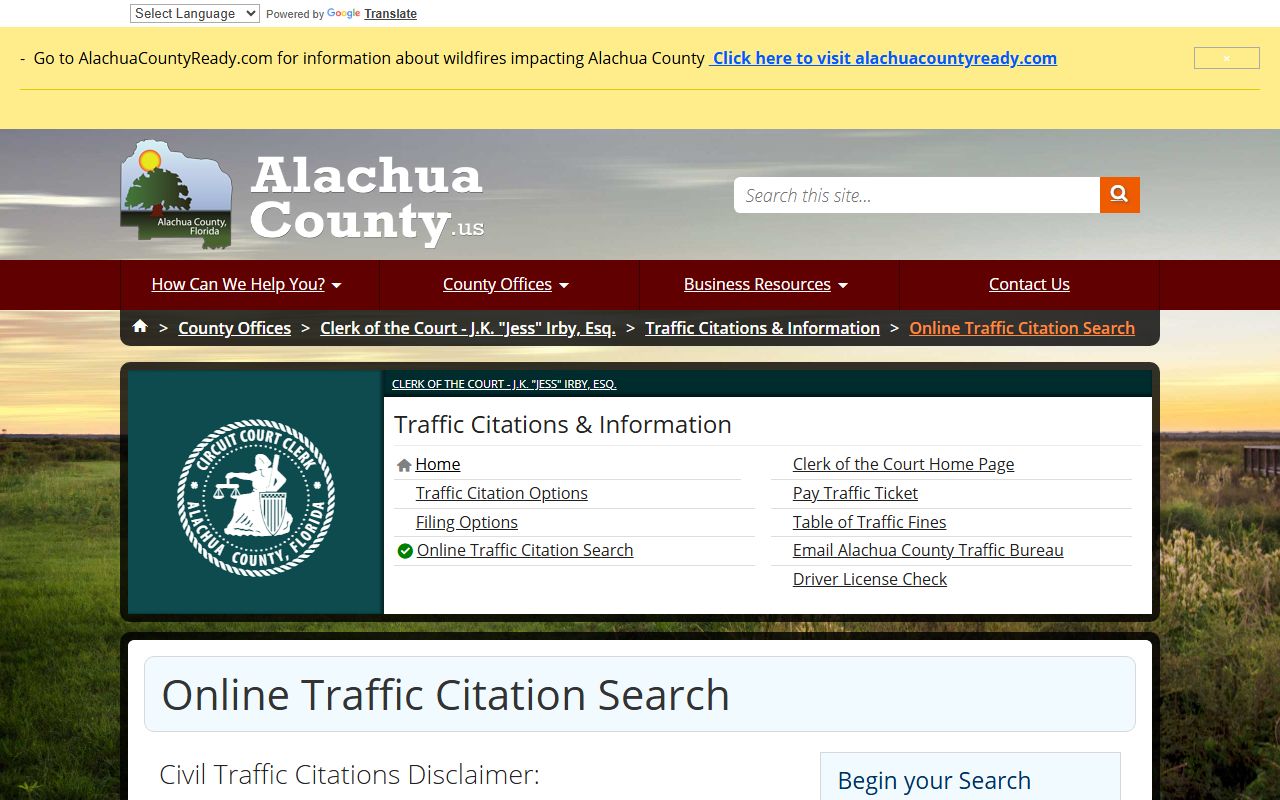
The online citation search shown above starts after the disclaimer. The table lists the search fields from the Clerk's instructions.
| Field Label | Type | Required | Notes / Format |
|---|---|---|---|
| Last Name | Text | For name search | At least 2 characters; partial matching works. |
| First Name | Text | For name search | At least 1 character. |
| Citation No. | Text | Alternative | The 8-character citation number from the ticket. |
Which Courts Handle Alachua County Traffic Cases
Traffic cases run through the county court level. The Clerk's Traffic Bureau manages civil traffic citations, with payment and filing at the Family and Civil Justice Center. The courthouse information page also says civil traffic citation payments can be made at the Criminal Courthouse on South Main Street, fourth floor. Criminal traffic, which is more serious, connects to the Criminal Courthouse.
So one ticket might be a civil infraction, while another is a criminal traffic charge. The County Court page covers the civil traffic level, and the arrest records page covers criminal traffic and booking. The Traffic Bureau line is 352-374-3609.
Types of Traffic Cases on Record
Not every traffic matter is the same. A civil traffic infraction, such as most speeding tickets, ends with a fine and possible points. A criminal traffic charge, such as driving with a suspended license, carries criminal consequences. DUI is its own category and routes as a criminal matter rather than a simple infraction. Knowing the type tells you how to handle the citation and where the record lives.
- Civil traffic infractions, handled by the county court.
- Criminal traffic charges, handled as criminal cases.
- DUI cases, which route to the criminal track.
- Citations tied to registration, insurance, or license issues.
What Alachua County Traffic Court Records Show
A traffic record carries the basics of a citation and its court handling. The exact fields depend on the citation, but the search instructions and the traffic workflow point to a common set. The table lists what a traffic record can include.
| Field | What It Shows |
|---|---|
| Name | The driver named on the citation. |
| Citation Number | The 8-character number on the ticket. |
| Issue / Compliance Date | When it was issued and the 30-day deadline. |
| Violation / Statute | The offense and the statute cited. |
| Status | Payment, plea, hearing, or school election status. |
| Amount / Late Fee | The fine and any added late fee. |
Searching by Citation Number vs by Name
You can search two ways, and each has a use. The citation number is exact, so it lands on one ticket. Enter the 8-character number from the ticket. A name search is broader, since partial matching works. Two characters of a last name and one of a first name can return many results, which helps when you do not have the ticket in hand but can be noisy for common names.
If a ticket does not appear yet, give it time. The Clerk says it may take up to seven working days for the issuing agency to submit a citation, so a brand-new ticket may not be in the index right away. The instructions page explains the name and number rules in detail.
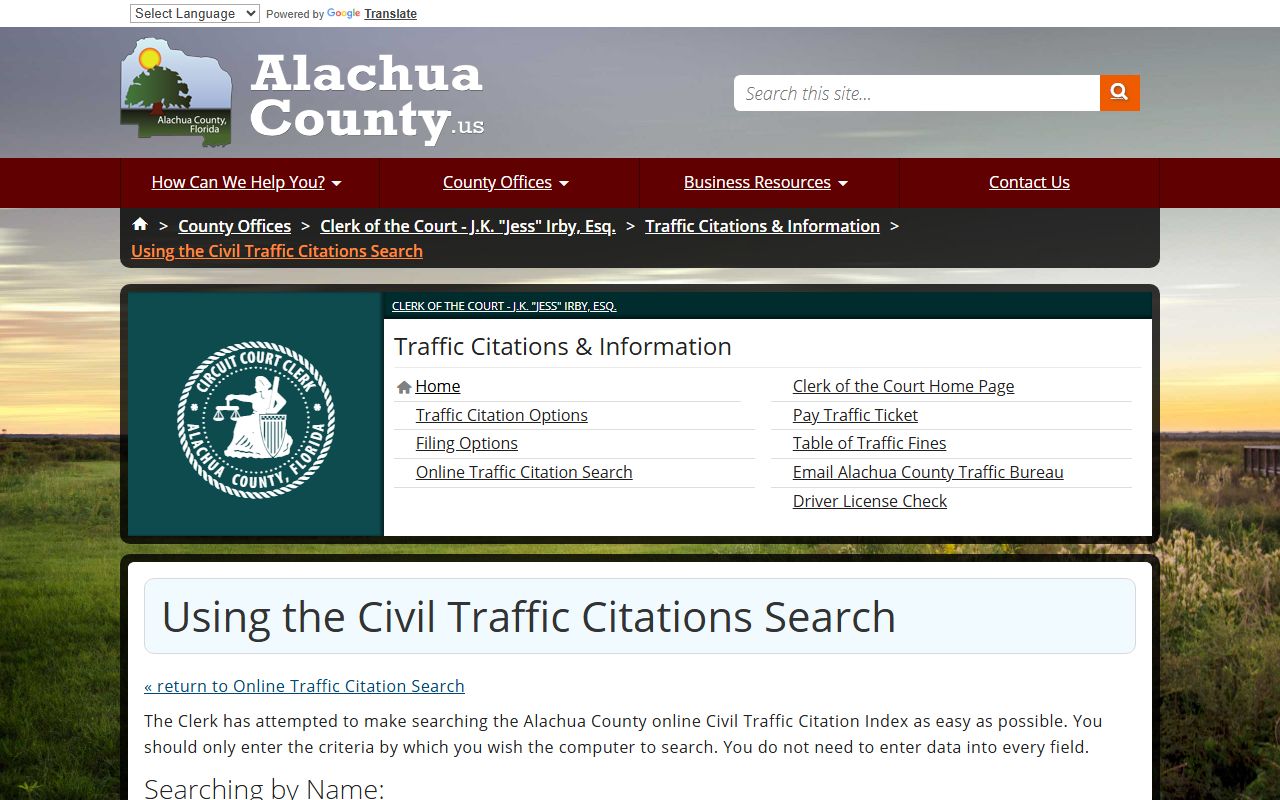
The citation search instructions shown above cover the character counts and partial matching.
Paying or Contesting an Alachua County Traffic Ticket
A driver has four options after a citation, and the deadline is 30 days from issuance. The Clerk's Traffic Citations and Information page lays out the choices. The screenshot shows that information page.
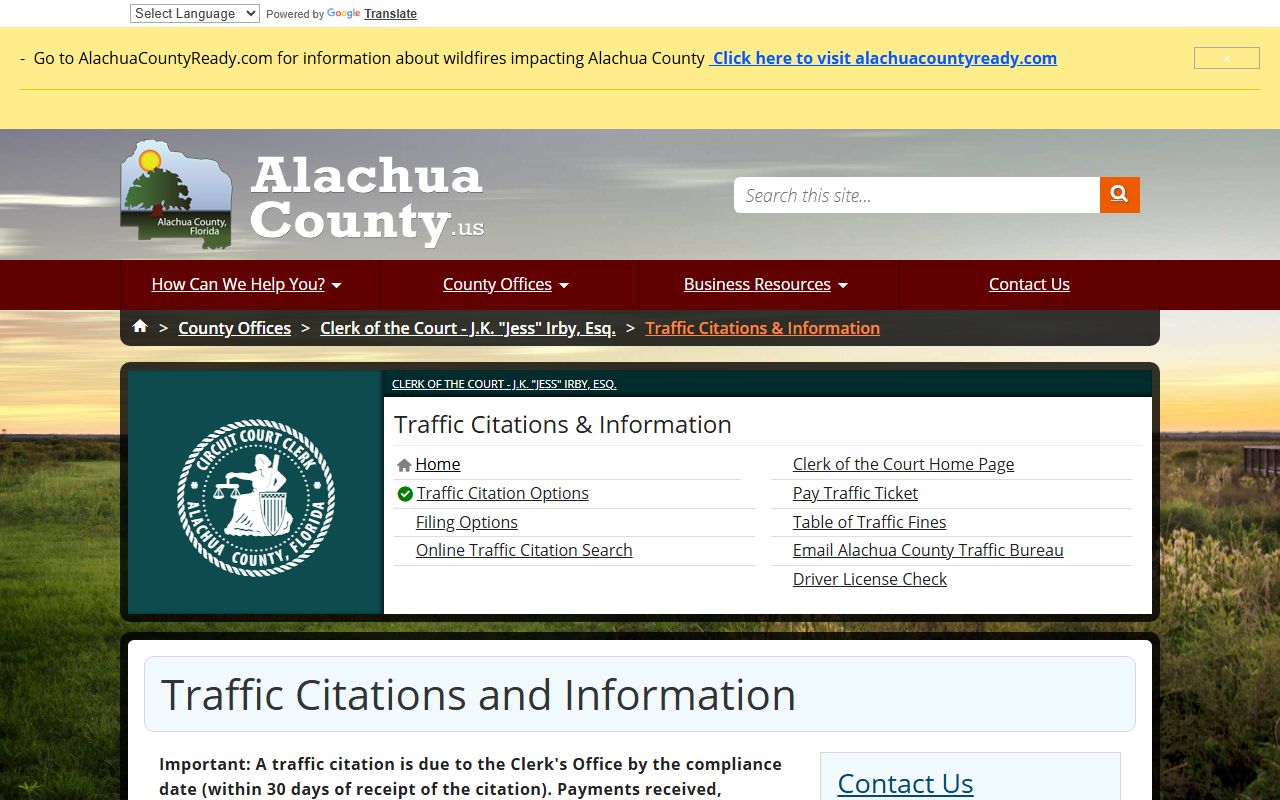
The traffic citations page shown above outlines the four options. The table sums them up.
| Option | Deadline | What It Does |
|---|---|---|
| Pay the citation | Within 30 days | Closes the citation; points may apply. |
| Elect traffic school | Within 30 days | Withholds adjudication; avoids points if completed. |
| Plea, no hearing | Within 30 days | Submit a written plea for the court to consider. |
| Plea, request hearing | Within 30 days | Contest the citation and ask for a hearing. |
Paying online or by phone can be done with a card, but it waives the right to contest, and a small service charge applies. The screenshot shows the payment page.
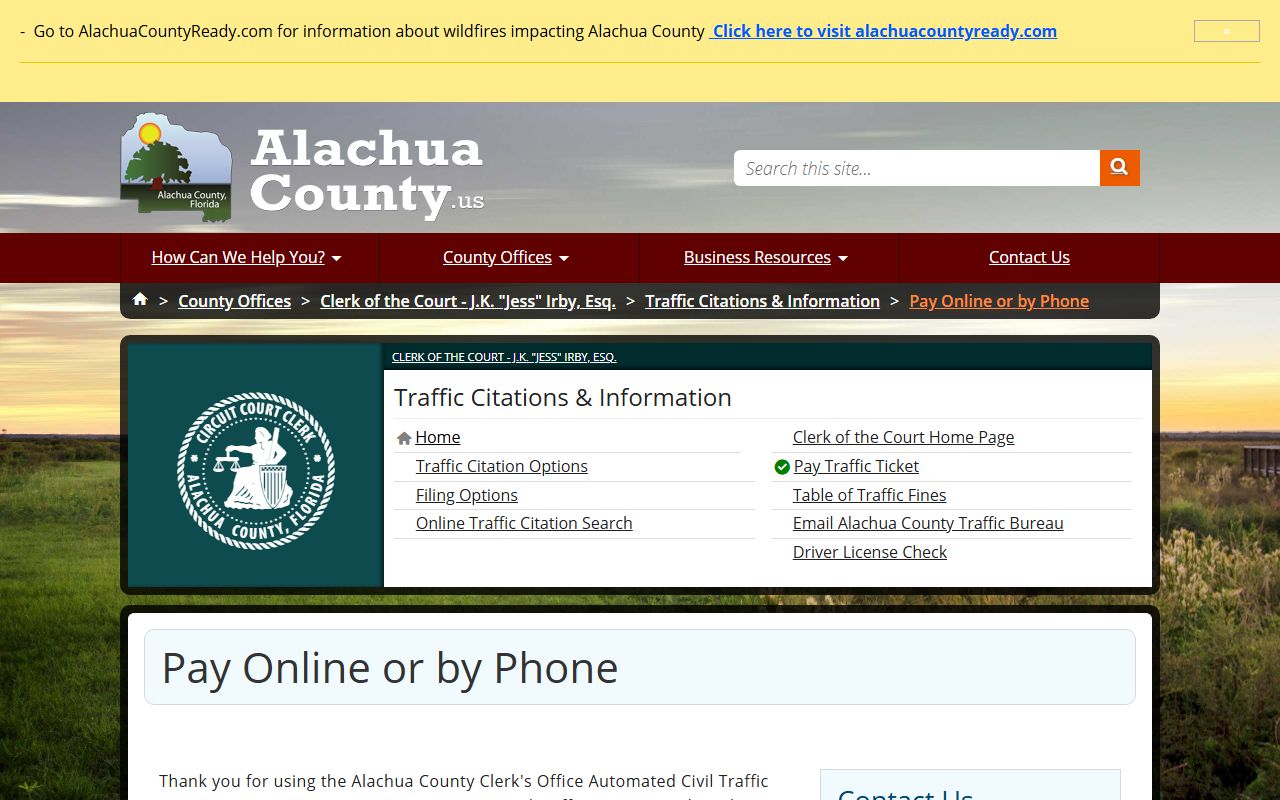
The pay-ticket page shown above warns that the automated system cannot be used for citations over 30 days old or for license, registration, or insurance citations. The steps below walk through the choice.
- Read the citation and find the 30-day compliance date.
- If the ticket is not online yet, wait, since agency submission can take up to seven working days.
- Search by the 8-character citation number or by name.
- Choose to pay, elect school, plead without a hearing, or request a hearing.
- Keep proof of payment, filing, or the school certificate.
Public Access Laws for Traffic Court Records
Traffic court records are public records under Florida law, like other court records, unless an exemption applies. Chapter 119 and Rule 2.420 set the framework. The Clerk's online citation index is one way the public sees these records, though it is limited to currently managed citations and is not the official index.
The Clerk also repeats Florida's email warning on its traffic pages, since an email address sent to the office can be a public record. The public records page covers the broader access rules and the email caution.
Court Traffic Records vs State Driver Records
This is the distinction that confuses the most people. A court traffic record is the Clerk's record of a citation and its court handling. A state driver record is the Florida Department of Highway Safety and Motor Vehicles record of a license, points, and history. They are different files, kept by different agencies. The comparison below sets them side by side.
| Feature | Court Traffic Record | State Driver Record |
|---|---|---|
| Custodian | Alachua County Clerk and county court | Florida DHSMV |
| Search by | Citation number or name | Driver license number and identity |
| Shows | Citation, court action, plea, disposition | License status, points, suspensions, history |
| Use case | Pay or contest, check a court date | Check eligibility, points, and driving history |
A court disposition can be reported to the state and become part of the driving record. So the two connect, but you request them from different places.
CDL and Commercial Driver Records
Commercial drivers face stricter rules. A citation that is minor for a regular driver can carry heavier consequences for a CDL holder, including separate state and federal reporting. The court traffic record and the state driver record both matter for a CDL, and a CDL holder often has fewer options to mask a violation. Because the rules are specialized, a commercial driver should confirm the current CDL consequences with the state and, where needed, a lawyer.
DUI and DWI Cases
DUI is not a simple civil traffic infraction. It routes as a criminal matter and can be a misdemeanor or a felony depending on the facts. That means it appears in the criminal channels rather than the civil traffic index, and it carries far higher stakes. A DUI case follows the criminal process, with booking, charges, and court hearings.
The arrest records page covers how a criminal traffic or DUI case connects to booking and the courts. Crash reports, by the way, are separate from traffic court records and come from the investigating agency or the state, not the citation index.
Deferred Options and Driver Improvement School
Electing traffic school can spare a driver from points. If the driver completes an approved Driver Improvement School on time, adjudication is withheld, points are not assessed, and the fine may be reduced. There are limits. A driver may elect this option only eight times in a lifetime, and at least one year must pass since the last election. After the Clerk gets the election and payment, the driver gets an extra 60 days to attend, and the certificate must be filed before the extended deadline.
The Clerk's traffic citation handout explains these deadlines and the late fee. The screenshot shows that handout.
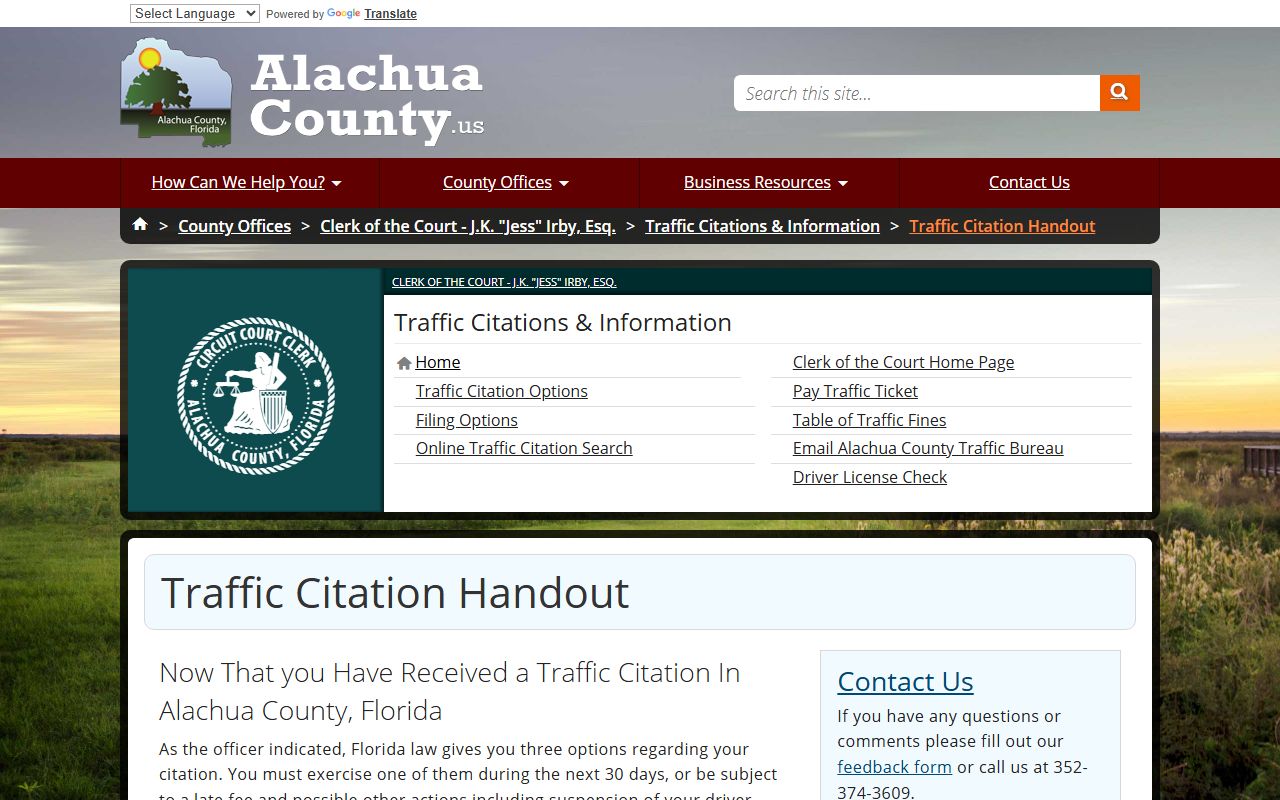
The traffic citation handout shown above lays out the 30-day options and the $23 late fee. Missing a deadline can mean adjudication, points, a suspension, and added fees.
Sealing or Expunging Traffic Records
Civil traffic infractions are not criminal, so the sealing and expunction process for criminal records does not apply to them in the same way. A criminal traffic case, such as a DUI, falls under the criminal record rules. For those, eligibility runs through the Florida Department of Law Enforcement and a court petition. The Clerk cannot decide eligibility or give legal advice.
The arrest records page covers sealing and expunction for criminal cases, including the statutes that govern them. A civil traffic record generally stays part of the public citation index unless the law provides otherwise.
Fees for Traffic Record Copies
Copies of a traffic court record follow the Clerk's standard copy fees. Online viewing of the citation index is free. A late fee applies to a citation paid after the compliance date. The table lists the common copy and late charges.
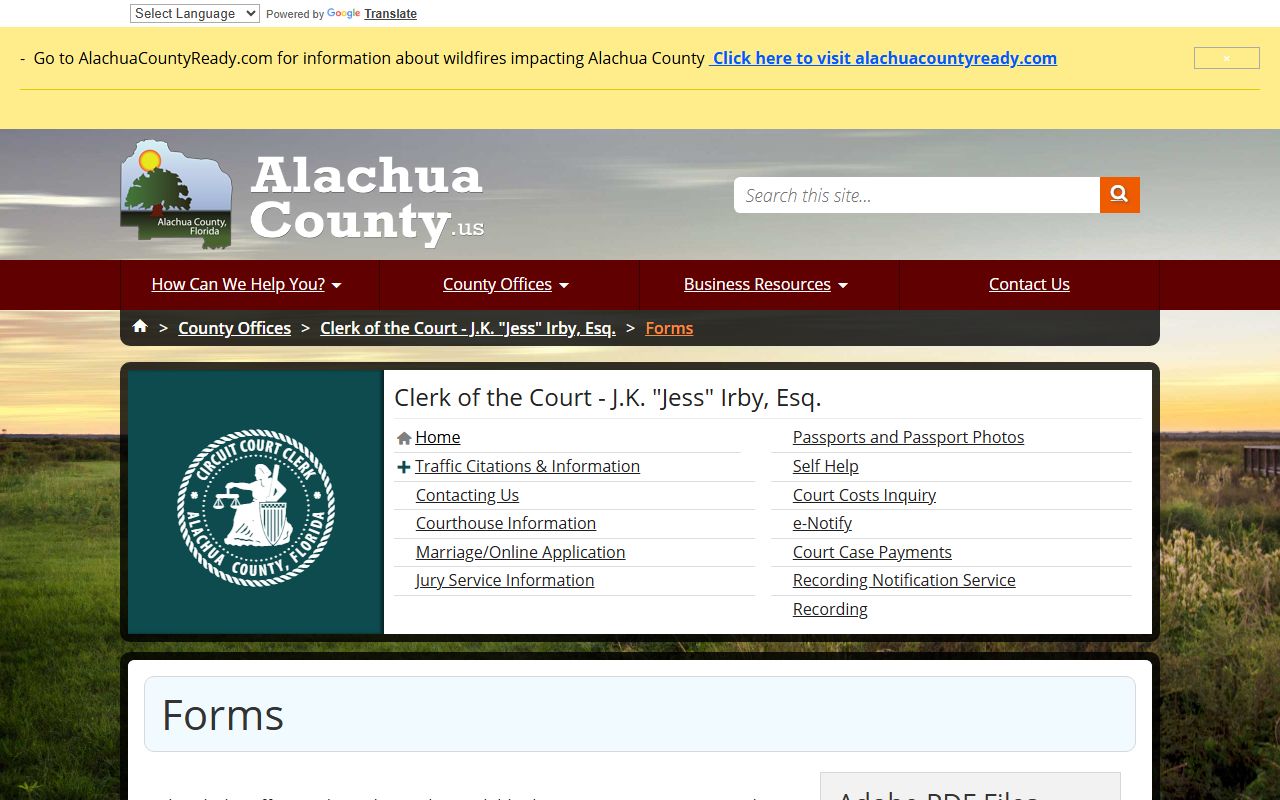
The Clerk forms library shown above includes traffic forms such as the school election and pleas. The fee table is below.
| Item | Amount |
|---|---|
| Copy, per page | $1.00 |
| Certified copy, per document | $2.00 added |
| Late fee after compliance date | $23.00 |
| Card payment service charge | Added by provider |