
How to Look Up Alachua County Jail Population Data
The starting point for jail population data is the Sheriff's roster. The all-inmate view lists everyone held at that moment, and counting its rows gives a live headcount. That number is a snapshot, not an official average, because the roster changes all day. For firm capacity numbers, the Department of the Jail page states the bed count and the optimum housed figure. For broader trends, state and national reports fill the gap.
So three sources work together. The Sheriff supplies the live roster and capacity facts. The Florida Department of Corrections and FDLE supply statewide criminal justice data. The Bureau of Justice Statistics supplies national jail context. None of these is a single dashboard, so reading population data means combining them and labeling each figure by its source.
This matters because population figures are easy to misuse. A roster count from one morning is not the same as an average across a month. A national rate is not a county rate. A community's census numbers are not the jail's numbers. Keeping each figure tied to its source avoids the common mistake of mixing them. The pages below break the data into pieces and note, for each one, whether it is a firm county fact or broader context.
Alachua County Jail Capacity Overview
The Department of the Jail is large for north central Florida. The Sheriff's page states a firm design capacity and an optimum number housed. These are official county figures, not estimates. The table sums them up.
| Facility | Beds | Optimum Housed | Notes |
|---|---|---|---|
| ACSO Department of the Jail, 3333 NE 39th Ave., Gainesville | 1,148 | 975 | 314,000 sq ft; adults up to one year; FCAC accredited. |
The core building was finished in January 1994, with upgrades in 2007 and 2009. The jail is accredited by the Florida Corrections Accreditation Commission and earned its fourth Excelsior award in October 2023. The Sheriff took over jail operations from the county on January 18, 1998, through an interlocal agreement, which is why the facility runs under the Sheriff today. The inmate records page covers the roster and contacts in detail.
Average Daily Population and the Live Snapshot
The county does not publish an official average daily population on the pages reviewed. What the public can see is the live roster count. When the all-inmate roster was inspected, it held roughly nine hundred current inmate rows. That sat below the 1,148-bed design capacity and below the 975 optimum number, but it was a one-time reading.
Because the roster is live, that count should not be treated as a fixed average. A single morning can differ from an afternoon as bonds post and bookings come in. So the honest way to use the roster is as a point-in-time snapshot, with the firm capacity numbers as the stable reference points. The count can rise after a busy weekend or fall after a round of bond hearings.
Note: A live roster count is a snapshot in time, not an official average daily population, so it shifts hour to hour.
Demographics Visible in the Roster
The roster shows some descriptors for each person. The columns include race, sex, age, housing pod, and arresting agency. These let the public see a basic profile, but the Sheriff's pages do not publish an aggregate demographic dashboard for the jail. So you can read one person's listed race and age, yet you cannot pull an official racial or age breakdown of the whole jail from the public pages.
For community context, the U.S. Census QuickFacts page describes Alachua County's resident population. These are county residents, not the jail population, and the two should not be confused.
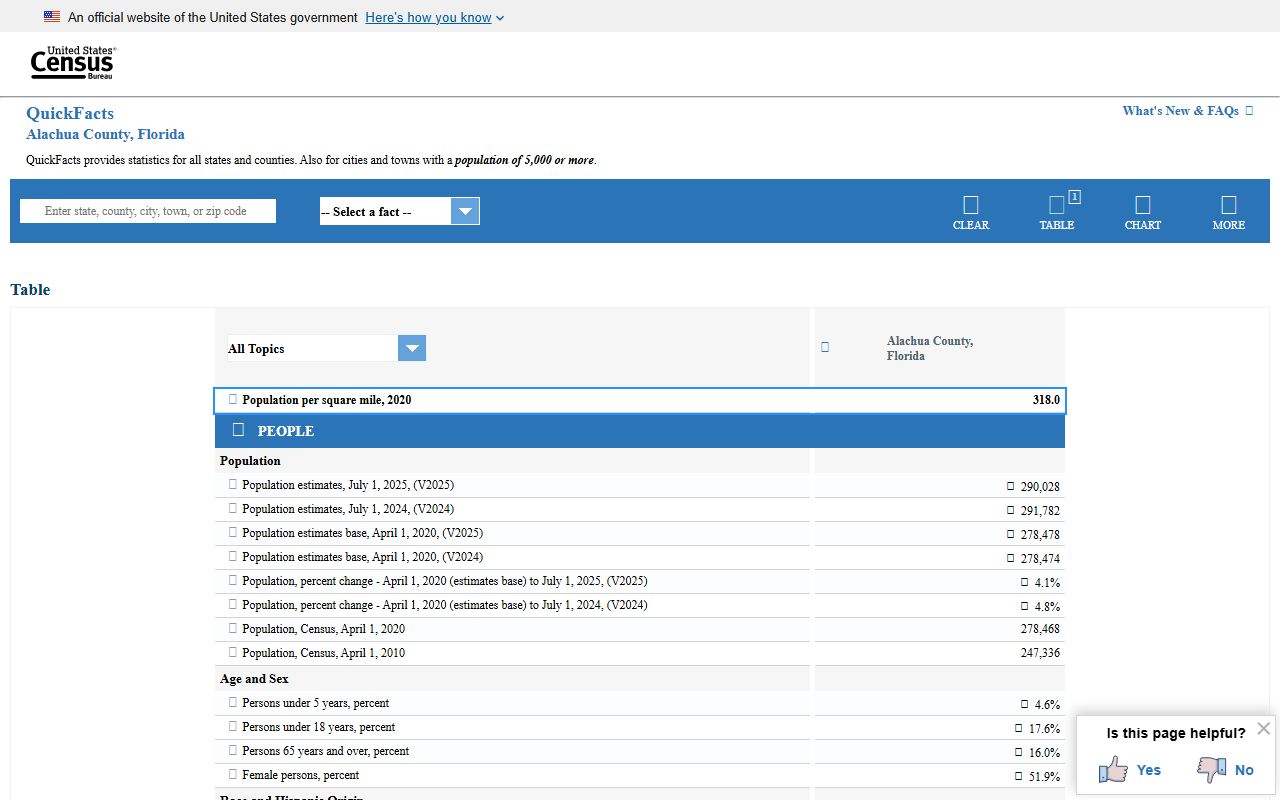
The Census QuickFacts page shown above lists county figures such as a 2025 population estimate near 290,028 and a 2020 count of 278,468. It is useful background for understanding the community the jail serves, not a measure of who is held. The page also reports land area, income, and race and ethnicity figures for county residents, which researchers sometimes use as a denominator when they compute a per-capita rate from a separate, dated jail count.
Pretrial vs Sentenced Population
Jails hold two broad groups. Some people wait for trial and have not been convicted. Others serve a short sentence after conviction. The Sheriff's public roster shows a custody status field, such as awaiting trial, on individual detail pages, but it does not publish an official pretrial-versus-sentenced split for the whole jail. The comparison below explains the two groups.
| Group | Who They Are | Where It Shows |
|---|---|---|
| Pretrial | Held while a case is pending, not yet convicted | Status field on the inmate detail page |
| Sentenced | Serving a county sentence after conviction | Status field on the inmate detail page |
Because the jail holds adults for up to one year, longer sentences move to state prison under the FDC. So the sentenced group in the county jail is, by design, serving shorter terms. The pretrial group can shift a lot with bond decisions, since a person who posts bond leaves while a case continues. That is part of why a daily count moves, and why no single number captures the jail for long.
Misdemeanor vs Felony Population
The jail holds people on both misdemeanor and felony matters. A misdemeanor case runs through county court, while a felony runs through circuit court. A roster detail page can show a status such as a misdemeanor awaiting trial. Still, the Sheriff's pages do not publish an official misdemeanor-versus-felony breakdown of the whole jail population.
This is one more place where the public sees individual records but not an aggregate report. For the case behind a charge, the Clerk's court records search shows whether a matter is a misdemeanor or a felony by its case-type code.
Mental Health and Medical Population
Health services are part of jail operations. Medical and mental-health care run under a contract that the Jail Director's office monitors through a contract compliance manager. The named provider is Wellpath. The unit offers mental-health services such as medication management, treatment planning, and crisis intervention.
The public roster does not flag a person's medical, protective-custody, or suicide-watch status, which protects privacy and safety. So while the jail clearly serves a population with health needs, the count of that group is not published on the public pages.
Mental health also shapes how some cases move. The Eighth Judicial Circuit runs a Mental Health Court, and the jail has a Forensic Program Director who helps identify candidates. That program can divert a person from a standard jail stay toward treatment and court review. So the health side of the population connects to the courts, not just to the jail's medical unit.
National and State Jail Context
To compare the county jail to others, national data helps. The Bureau of Justice Statistics publishes national Jail Inmates reports that set a baseline for jail populations across the country. These are federal figures, not Alachua County figures, so they offer context rather than a local count.
The Bureau of Justice Statistics shown above is the source for national jail data. The table shows which level supplies which kind of data, since there is no single rate published for the county jail.
| Level | Data Source | What It Covers |
|---|---|---|
| County | Sheriff's roster and jail pages | Live count, capacity, individual records |
| State | Florida DOC and FDLE | State prison and supervision, criminal history |
| National | Bureau of Justice Statistics | National jail population baselines |
Population Trends Over Time
A multi-year trend chart needs a consistent data series. The official pages reviewed do not publish a five-year Alachua County jail population trend. Building one would mean pulling figures from ACSO annual reports, county budget documents, Florida jail inspection data, and national reports. Those sources exist, but a verified local series was not part of the official pages here.
So the firm local facts remain the 1,148-bed design capacity, the 975 optimum number, and the live roster structure. Anyone presenting a trend should cite the underlying reports rather than rely on a single roster snapshot, which only captures one moment. A responsible trend would note the date of each figure and the report it came from, so a reader can check it. Without that, a chart can look precise while resting on mixed or dated sources.
Searching for Alachua County Inmate Records by Name
This page covers population data, not individual lookups. To find one person, use the Sheriff's roster on the inmate records page, which searches by name or booking number. For a person in state prison, the Florida DOC offender search works by name or DC number, and its detail page shows a sample record structure.
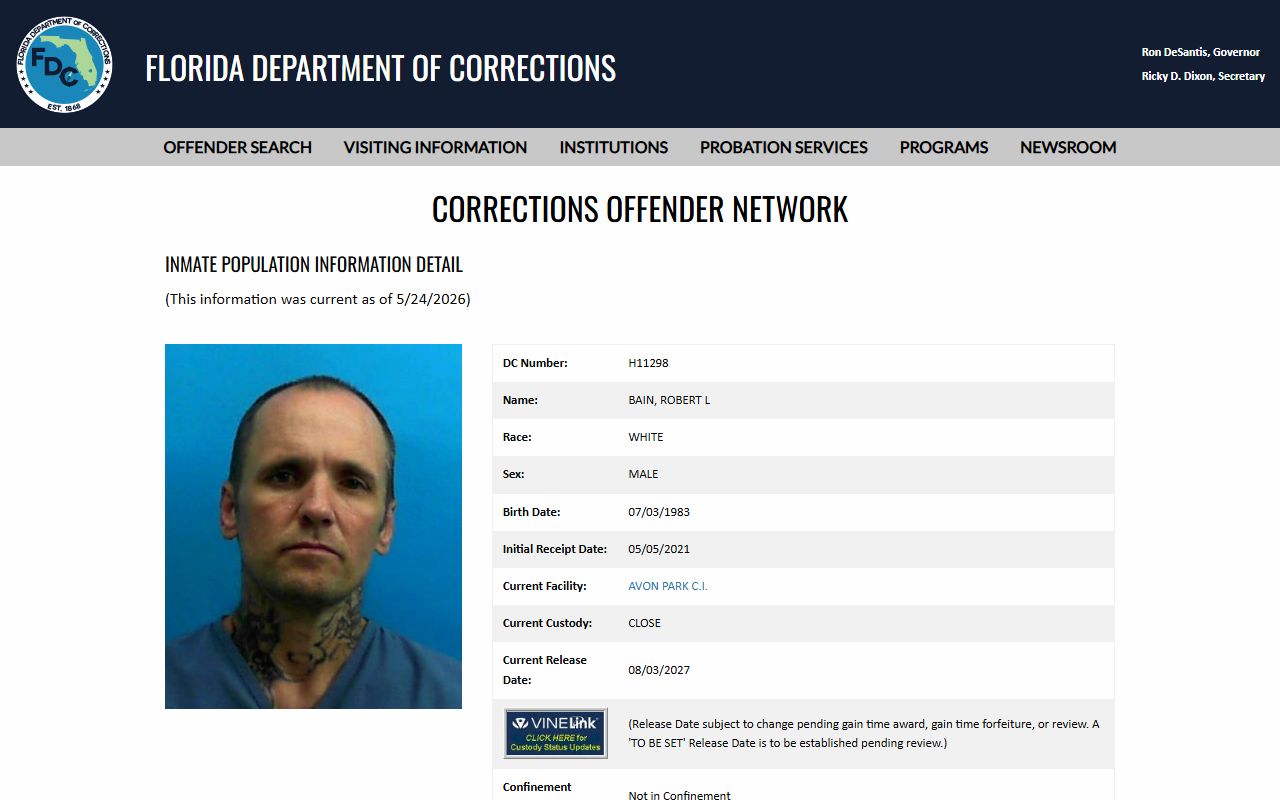
The Florida DOC offender search shown above carries a current-as-of date and covers felony offenders in state prison or supervision. The released inmates page explains its fields and the federal locator.
Where the Data Comes From
Knowing the source keeps the numbers honest. The capacity and roster facts come from the Alachua County Sheriff's Office. The state offender data comes from the Florida Department of Corrections and FDLE. The national context comes from the Bureau of Justice Statistics. Community population background comes from the U.S. Census. Each answers a different question, and none alone gives a full picture of the jail.
For the court side of a case, the Clerk's court records and court dockets searches show filings and outcomes. Together with the jail roster, they let the public follow a case from booking to disposition.