
How to Find Alachua County Arrest Records
The fastest path to a recent arrest is the Sheriff's inmate lookup. The Alachua County Sheriff's Office runs a public roster of people held in the county jail. You can search by last name, first name, or booking number, and partial entries work. The roster shows the booking date and time, so it doubles as a recent-arrest list for people still in custody. For someone already released, the live roster will not show them, and you may need to check court records or call the jail. The jail's main phone is 352-491-4444.
Arrest records and court records are not the same file. An arrest record or booking record comes from the Sheriff. A criminal court record comes from the Clerk once a case is filed. A statewide criminal history comes from the Florida Department of Law Enforcement. Because each custodian has its own update cycle, one search may not show everything. For the full case history after an arrest, use the Alachua County court records search, and for the jail roster detail, use the inmate records page.
Arrest Record vs Criminal Court Record
It helps to see the two side by side before you search. An arrest record captures the booking event. A criminal court record captures the case that may follow. They come from different offices and answer different questions.
| Feature | Arrest / Booking Record | Criminal Court Record |
|---|---|---|
| Custodian | Alachua County Sheriff's Office | Clerk of the Court & Comptroller |
| Shows | Booking, charges at arrest, bond, custody status | Filings, pleas, disposition, sentence |
| Where to look | Sheriff inmate lookup | Clerk court records search |
| Starts when | A person is booked into the jail | The State Attorney files charges |
The Alachua County Jail Roster
The Sheriff's all-inmate roster lists everyone held in the Department of the Jail at that moment. The columns include last name, first name, full name, booking date and time, race, sex, age, housing pod, and arresting agency. The roster is live and changes throughout the day, so the same person may move pods or drop off the list after release. Arresting-agency codes appear as short tags such as GPD for Gainesville Police, ASO for the Sheriff's Office, and DOJ in the jail context.
Each person on the roster links to a detail view. That detail page adds the MNI number, the case number, the court case number, the bond amount, the custody status, the charge number, the statute, and the charge description. One useful detail for record seekers is the court case number, which appears in Florida's uniform format and can be carried over to the Clerk's court records search. The roster does not show a date of birth, only an age, which is a privacy limit. The inmate records page breaks down every roster field.
Mugshots and Booking Information
Booking creates a record with the basics of an arrest. The jail assigns an MNI number, logs the booking date and time, and records the charges as stated by the arresting agency. A photo column appears on the roster, though whether a mugshot shows depends on the page and image. Charge descriptions often use all-capital statutory shorthand, so a single line can read like a string of legal abbreviations. Bond amounts may appear grouped by case or charge.
Booking data is public for most arrests, but it is an early snapshot. The charge at booking can change. The State Attorney decides what to file, and a judge sets bond and first appearance. So a booking charge is not proof of guilt and not the final word on the case.
Private mugshot sites are a common trap. Many copy public booking data and then charge to remove it. The Sheriff's roster is the official source, and it is free to search. If you want the most reliable picture of an arrest, use the Sheriff's lookup and the Clerk's court record together, not a third-party site. The jail roster also drops a person once they leave custody, so a name missing from the roster does not erase the arrest, it just means the person is no longer held there.
Charges vs Convictions in Alachua County
This is the distinction that matters most when you read an arrest record. A charge is an accusation. A conviction is a finding of guilt by plea or trial. Many arrests never become convictions. A case can be dropped, dismissed, or resolved with adjudication withheld.
| Point | Charge | Conviction |
|---|---|---|
| What it is | An accusation at or after arrest | A finding of guilt |
| Decided by | Arresting agency, then State Attorney | A plea or a verdict |
| Found in | Booking record, charging document | Case disposition and judgment |
| Final? | No, the case can end many ways | Yes, subject to appeal |
Felony and Misdemeanor Records
Alachua County criminal cases split by level. Felony cases run through the circuit court and connect to the Criminal Courthouse on South Main Street. Misdemeanor and criminal traffic cases run through the county court. The Clerk indexes both, but online document images start in December 2005, and many closed criminal files before 1990 are not online. Those older files are pulled at the Records Department.
For the full charge and case history, the court records search is the tool, since it shows the charging document, pleas, and disposition. For DUI and other criminal traffic matters, the traffic court records page explains how those cases route through the system.
The level of a charge shapes where it is heard and how serious it is. A felony can carry more than a year in state prison, while a misdemeanor carries up to a year in the county jail. Circuit judges handle the felony docket. County judges handle the misdemeanor docket. A felony case may also pass through a first appearance, an arraignment, and pretrial steps before any trial, and each of those events shows on the court docket once the case is filed.
Sealing and Expunction of Alachua County Records
Florida lets some people seal or expunge a qualifying criminal history record. The two are not the same. Sealing makes a record confidential but keeps it. Expunction removes the record from routine access and can have it destroyed, subject to exceptions. The State Attorney's Office posts seal and expunge information for the Eighth Judicial Circuit.
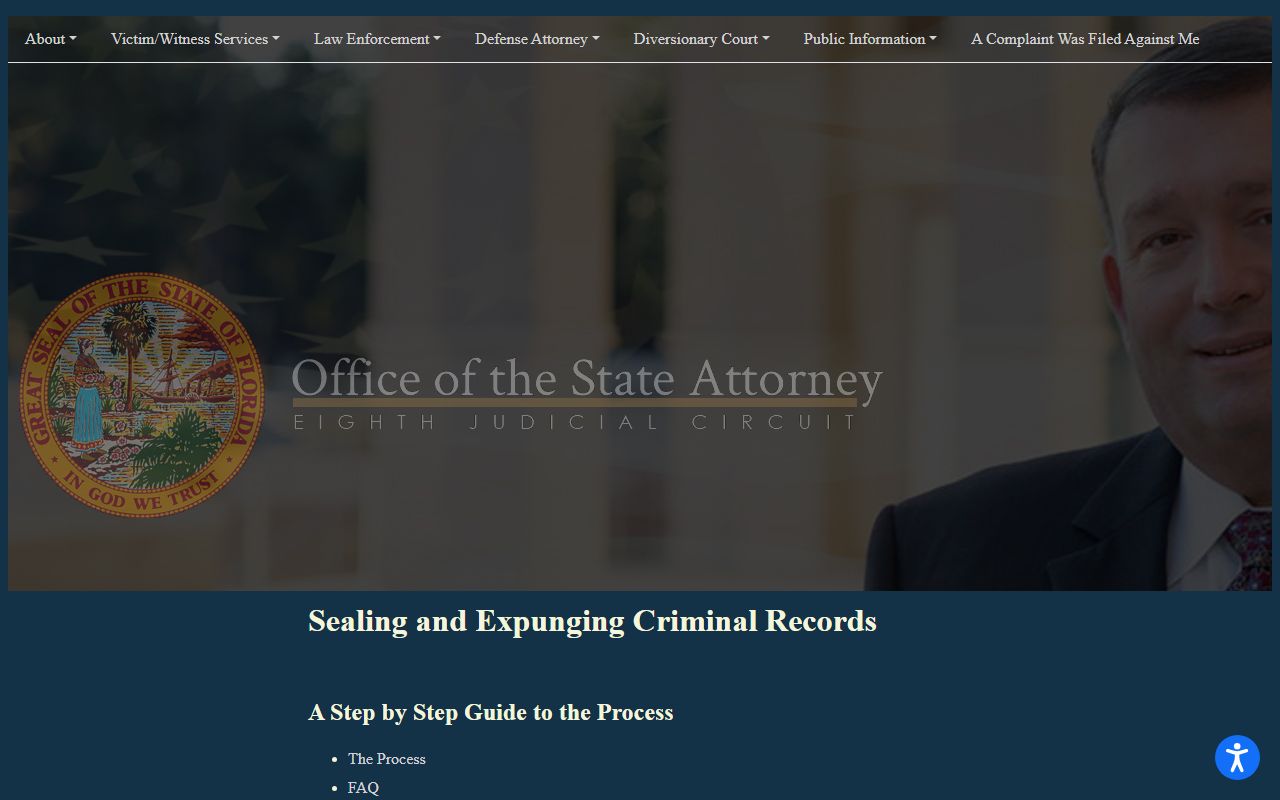
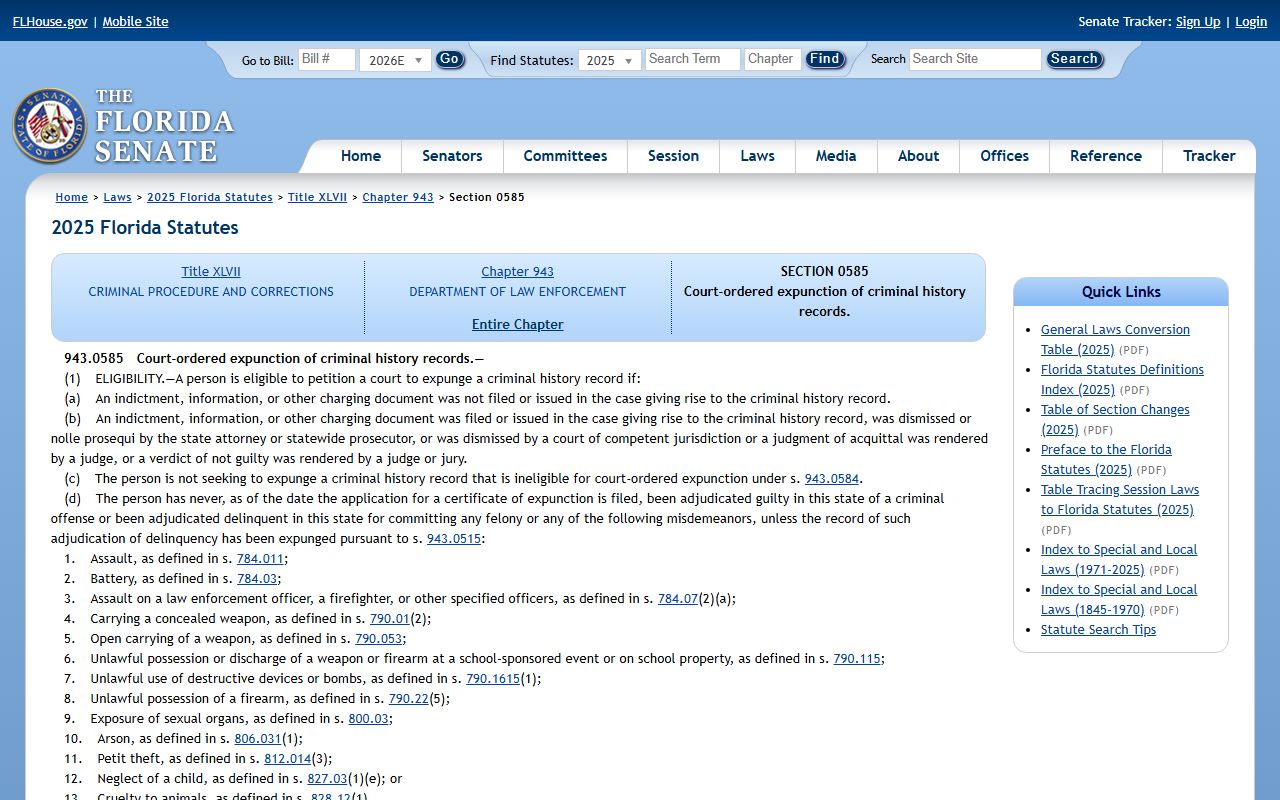
The State Attorney seal and expunge page shown above outlines the process. The governing law for expunction is Florida Statutes § 943.0585.
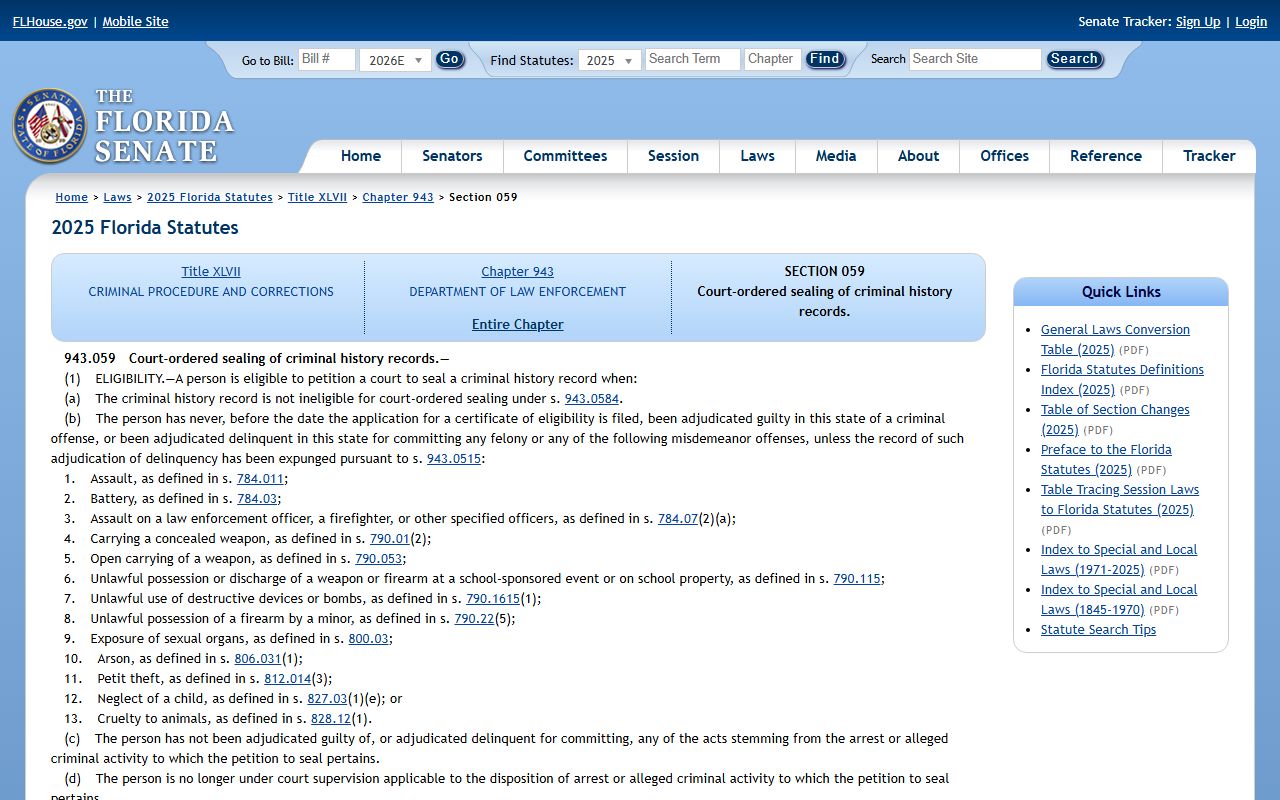
Sealing follows a separate statute, Florida Statutes § 943.059, shown below.
The process usually starts with an eligibility review by the Florida Department of Law Enforcement and a certificate of eligibility. The Clerk's Expungement line is 352-337-6215. The comparison below sums up the difference.
| Feature | Sealed | Expunged |
|---|---|---|
| Record kept? | Yes, but made confidential | Removed from routine access |
| Statute | § 943.059 | § 943.0585 |
| Public search | Hidden from public view | Hidden from public view |
| Agency access | Limited statutory access | Limited statutory access |
Note: The Clerk cannot decide eligibility or give legal advice on sealing or expunction, so confirm your options with FDLE, the State Attorney, or counsel.
State Attorney and Public Defender
Florida calls the prosecutor the State Attorney. The State Attorney's Office for the Eighth Judicial Circuit serves Alachua and five nearby counties, and it decides what charges to file after an arrest. The State Attorney is Brian Kramer.
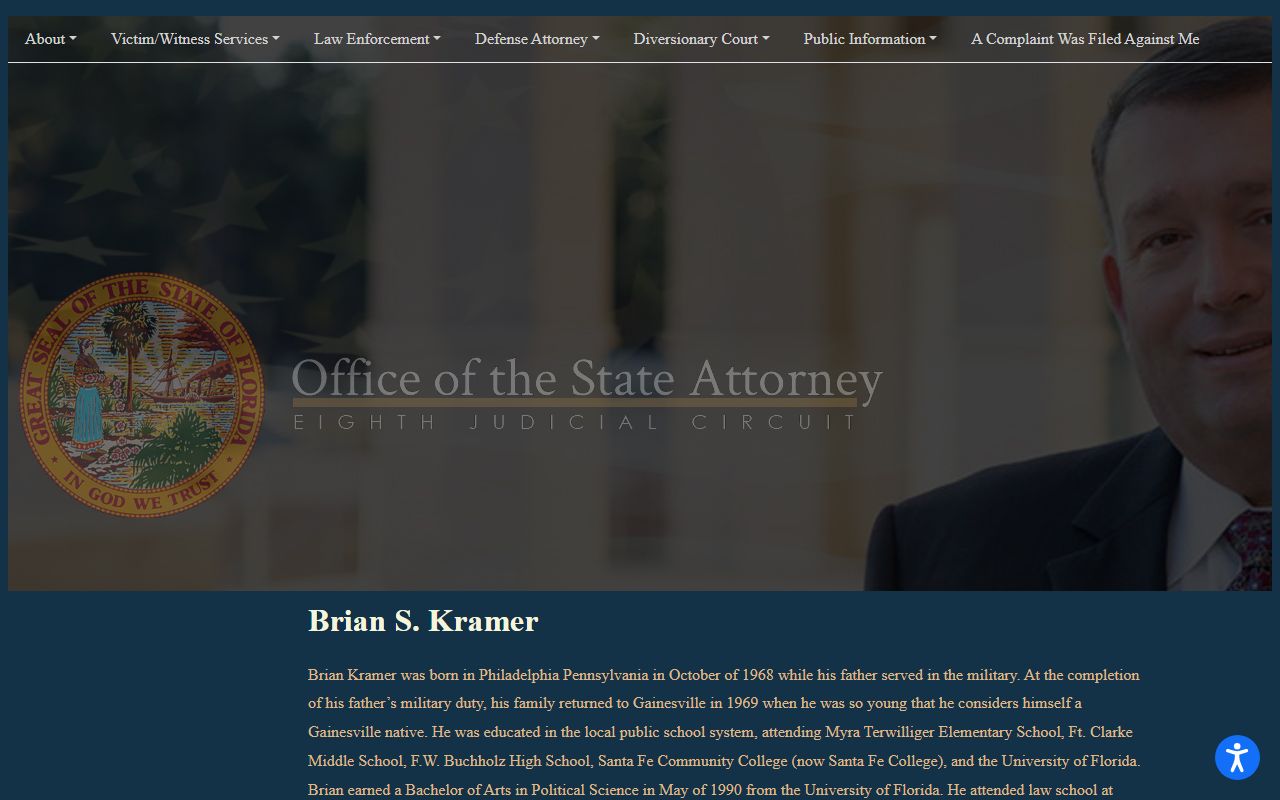
The State Attorney profile page shown above introduces the office that prosecutes county cases. The office also publishes victim rights information for people affected by crime.
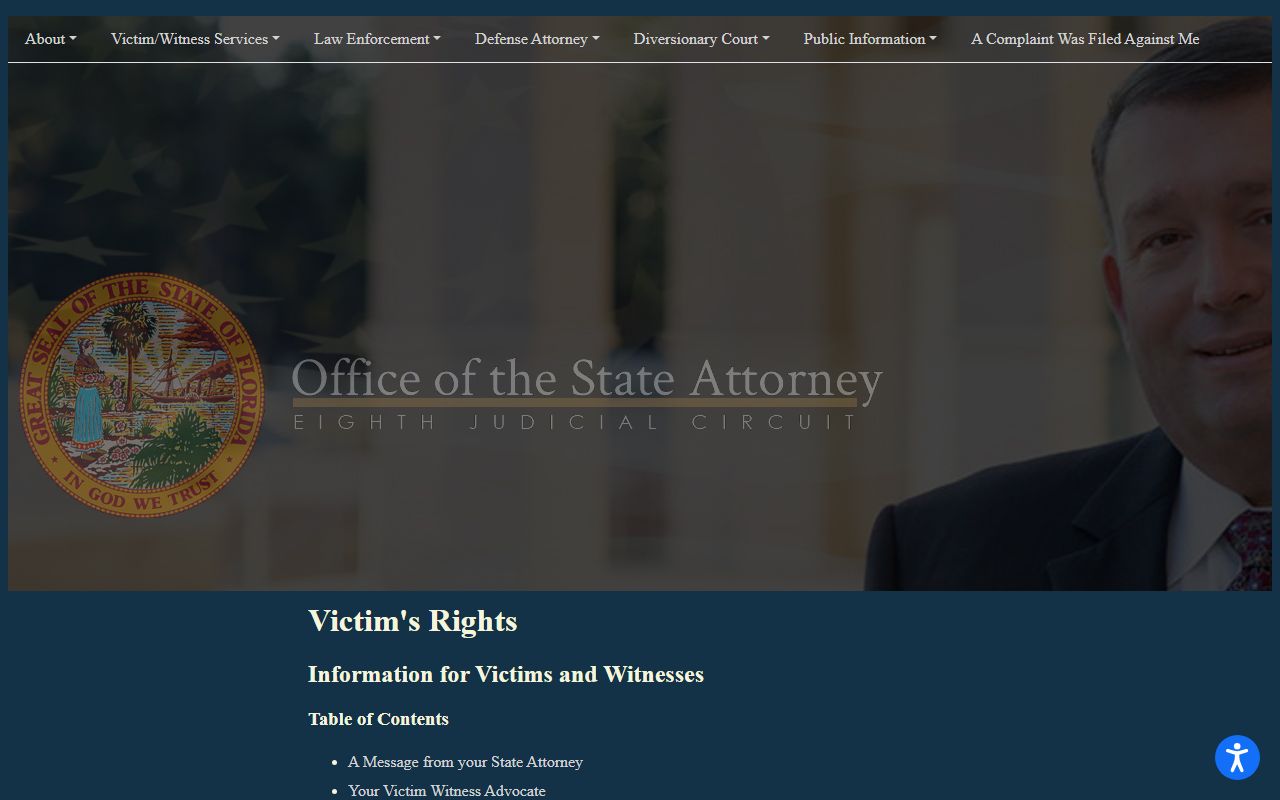
The victim rights page covers help for victims, while the Public Defender represents people who cannot afford a lawyer. Public Defender Stacy A. Scott leads the office for the Eighth Judicial Circuit.
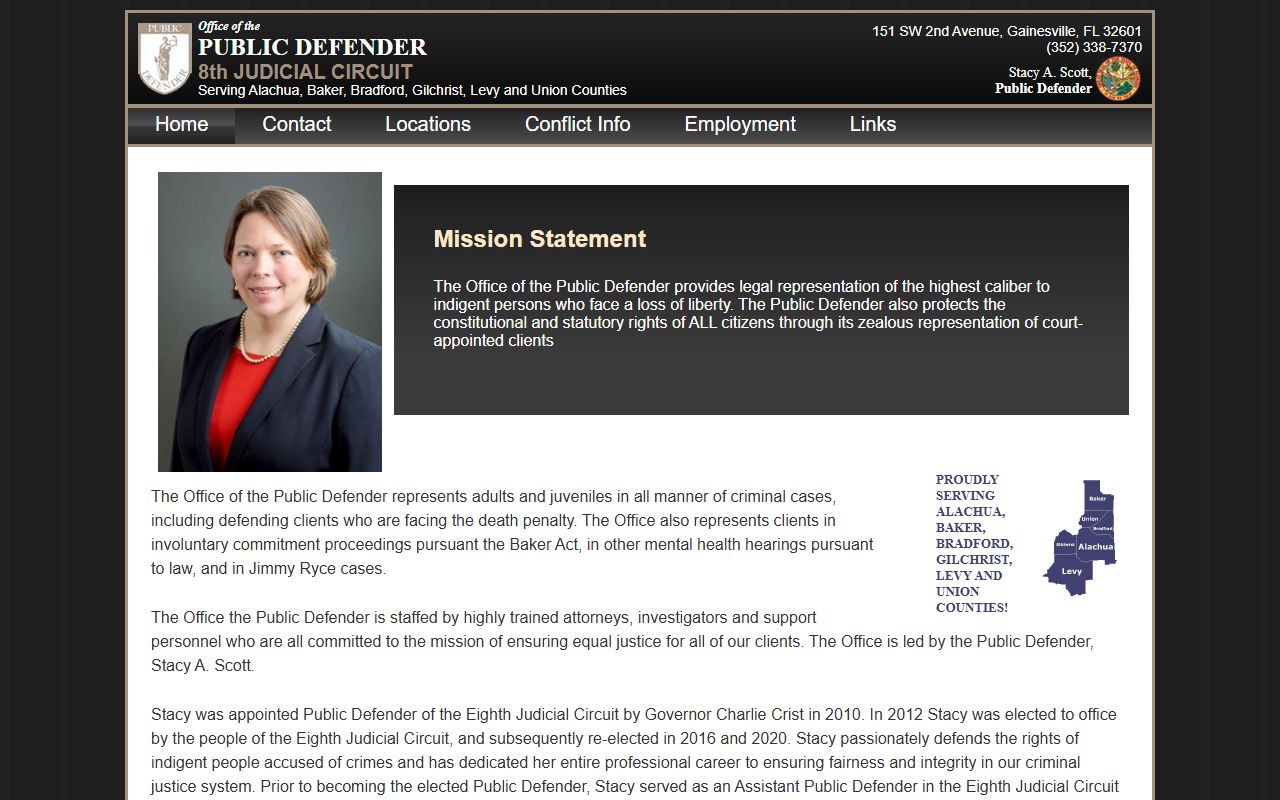
The Public Defender's office shown above represents indigent people facing loss of liberty, including adults and juveniles. The office is at 151 SW 2nd Avenue in Gainesville, phone 352-338-7370.
Public Access and Restricted Arrest Records
Florida's public records law, Chapter 119, makes most arrest and court records open. Active criminal investigative information can stay exempt while a case is open. Juvenile records are restricted under Florida Statutes § 985.045, so a juvenile arrest may not appear in a public search. Victim and witness details may also be protected under Marsy's Law and statutory exemptions.
For active warrant questions, the Sheriff's Warrants Bureau is the source, and the warrant records page explains the surrender and summons process. Remember that an arrest is public, but the case outcome controls how the record reads over time.
Statewide criminal history is a separate layer. The Florida Department of Law Enforcement keeps the state criminal history database, and a formal background check goes through FDLE rather than the county. A county search shows local arrests and local cases. A state search can pull a person's record across Florida. For a job, a license, or a tenant screening, the FCRA and Florida law set rules on how that data may be used, which is why this site is not a screening tool.