
Official Alachua County Inmate Search
The Sheriff's Office hosts the official inmate lookup for the county jail. It lets the public see whether a person is currently held in the Alachua County Jail. The search is free and needs no account. You can enter a last name, a first name, or a booking number, and partial entries are allowed. The search is not case sensitive, so capitalization does not matter. A View All button shows the entire current roster, though the page warns it can take a few minutes to load.
The lookup form is the front door to the jail roster. The screenshot shows the search fields and the buttons.
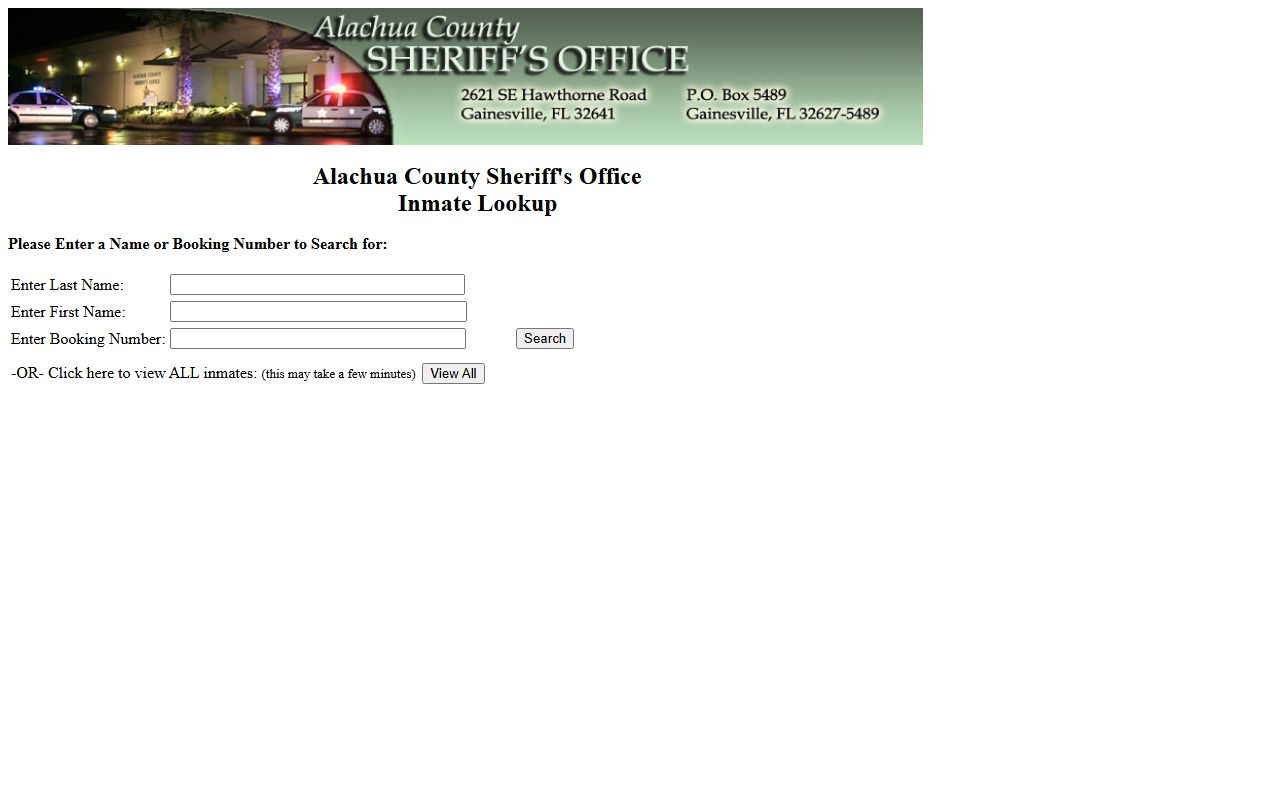
The Sheriff's inmate lookup shown above is the tool to start with. The table lists each field and how it behaves.
| Field Label | Type | Required | Notes / Format |
|---|---|---|---|
| Enter Last Name | Text | No | Partial entries allowed; not case sensitive. |
| Enter First Name | Text | No | Partial entries allowed; not case sensitive. |
| Enter Booking Number | Text | No | Use if you know the booking number. |
| Search | Button | N/A | Submits the search criteria. |
| View All | Button | N/A | Shows all current inmates; may take a few minutes. |
The Alachua County Jail Roster
The all-inmate roster lists everyone held in the Department of the Jail at that moment. It is a live view, so people move on and off it as bookings and releases happen. Each row carries the basics, and the row links to a fuller detail page. When inspected, the roster held roughly nine hundred current inmate rows, well below the jail's design capacity, but that figure shifts hour to hour.
The roster columns give a quick read on each person. The image shows the View All listing with its columns.
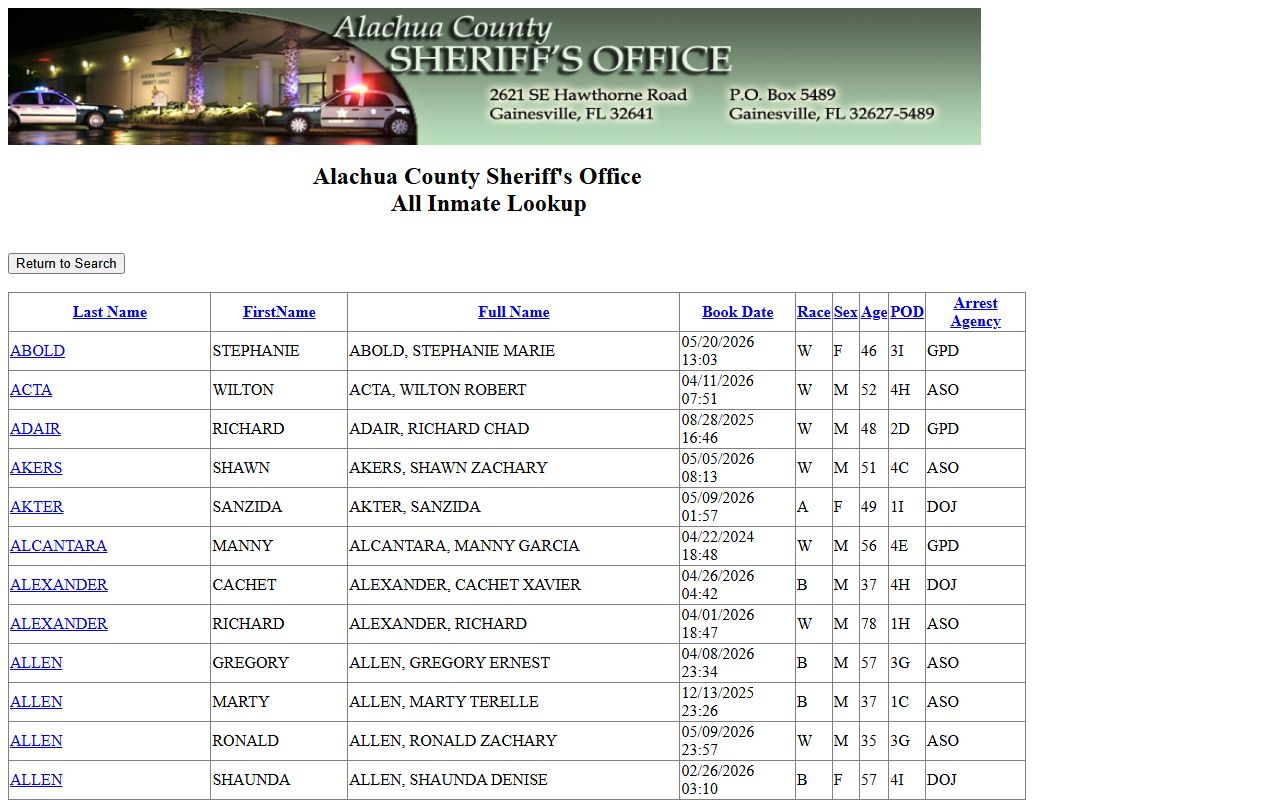
The all-inmate roster shown above can be sorted by column. Sorting by book date can help you find a recent arrival, while sorting by name helps when you only know part of a name. The columns are listed below.
| Column | What It Shows |
|---|---|
| Last / First / Full Name | The inmate's name, each sortable. |
| Book Date | Booking date and time, such as 05/20/2026 13:03. |
| Race / Sex / Age | Basic descriptors; age shows instead of a birth date. |
| POD | Housing pod code, such as 3I or 4H. |
| Arrest Agency | Agency code, such as GPD, ASO, or DOJ. |
To use the roster well, follow a simple order.
- Open the Sheriff's inmate lookup page.
- Enter a last name, or a last and first name, or a booking number.
- Submit the search, or choose View All for the full roster.
- Click a result row to open the detail page.
- Note the court case number to look up the case with the Clerk.
How to Read an Alachua County Inmate Detail Page
The detail page adds far more than the roster row. It carries an MNI number, the booking date and time, the housing pod, and the arrest agency. It also pairs a jail case number with a court case number in Florida's uniform format, plus the bond amount, the custody status, and the charge details. The court case number is the one to carry over to the Clerk's court records search.
A sample lookup result shows how these fields appear in practice. The screenshot shows an individual inmate result from the Sheriff's lookup.
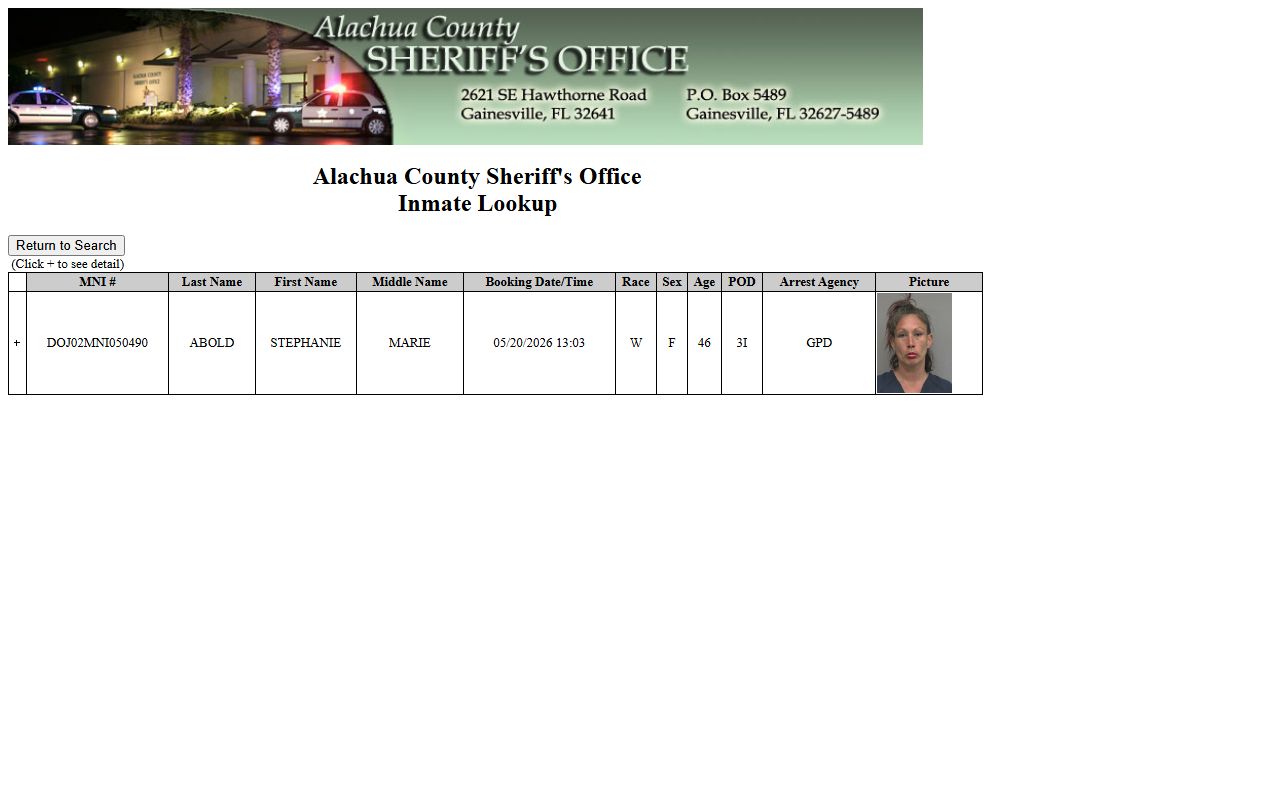
A result like the one shown comes from the Sheriff's inmate lookup. The table below lists what an inmate profile can show.
| Field | What It Shows |
|---|---|
| MNI # | The master name index number for the person. |
| Name | Last, first, and middle name. |
| Booking Date / Time | When the person was booked into the jail. |
| POD | The general housing pod, such as 3I. |
| Court Case Number | Florida uniform case number, such as 012026MM001060A. |
| Bond Amount | Bond per case or charge group, such as $5,000.00. |
| Status | Custody status, such as MISD - AWAIT TRIAL. |
| Statute / Charge | The statute number and the charge description. |
The inmate lookup drives both the roster and the detail view. Charge text often uses all-capital statutory shorthand, and bond may be grouped by case.
Booking, Bond, and Case Numbers
Booking is the intake step after an arrest. The jail records the person's name, an MNI number, the booking time, the arrest agency, and the charges as stated by that agency. Bond may already be set, or it may wait for a first appearance before a judge. Bond can show per case or per charge, so one person can have more than one bond line.
The court case number is the bridge between the jail and the courts. A roster entry may show a jail case grouping like CASE0001 next to a court case number in the state's format. For Clerk searches, the court case number is the useful one. The arrest records page explains how booking, charges, and court cases connect.
First appearance is a key early step. Within a day of booking, a person usually sees a judge who reviews the charge and addresses bond. That hearing is a court function, not a jail function, so the exact timing follows Florida criminal rules and the local schedule. Until bond is set or posted, a person stays in custody, and the roster keeps showing them. Once bond is posted and processing is done, the person is released, and the roster drops the entry.
Alachua County Jail Facility and Capacity
The Department of the Jail is a large facility for north central Florida. It holds 1,148 beds across 314,000 square feet and houses adult men and women for up to one year. The core building was finished in January 1994, with upgrades in 2007 and 2009, and the optimum number housed is 975. The jail is accredited by the Florida Corrections Accreditation Commission and earned its fourth Excelsior award in October 2023. Jail Director Major Dorian Keith commands the facility.
Department of the Jail Contacts
The jail runs several bureaus, each with its own line. These help when you need a specific unit rather than the main desk. Medical and mental-health services run under contract and are monitored by the Jail Director's office.
| Unit | Phone |
|---|---|
| Department of the Jail | 352-491-4444 |
| Medical Services | 352-491-4448 |
| Booking Support Bureau | 352-491-4449 |
| Classification Unit | 352-491-4447 |
| Inmate Trust Fund Coordinator | 352-491-4461 |
| Trinity Commissary | 352-491-4524 |
Visitation at the Alachua County Jail
All inmate visits must be scheduled at least 24 hours ahead through the jail's video visit provider. On-site visits are non-contact. Eligible inmates not on disciplinary confinement get up to two hours of visitation per week, available Sunday through Saturday on the housing schedule. Visitors need a valid ID, such as a driver license, state ID, military photo ID, or passport, and must clear screening. A remote internet option adds paid visits from home.
The video visit system handles both on-site and remote scheduling. The screenshot shows the scheduling page.
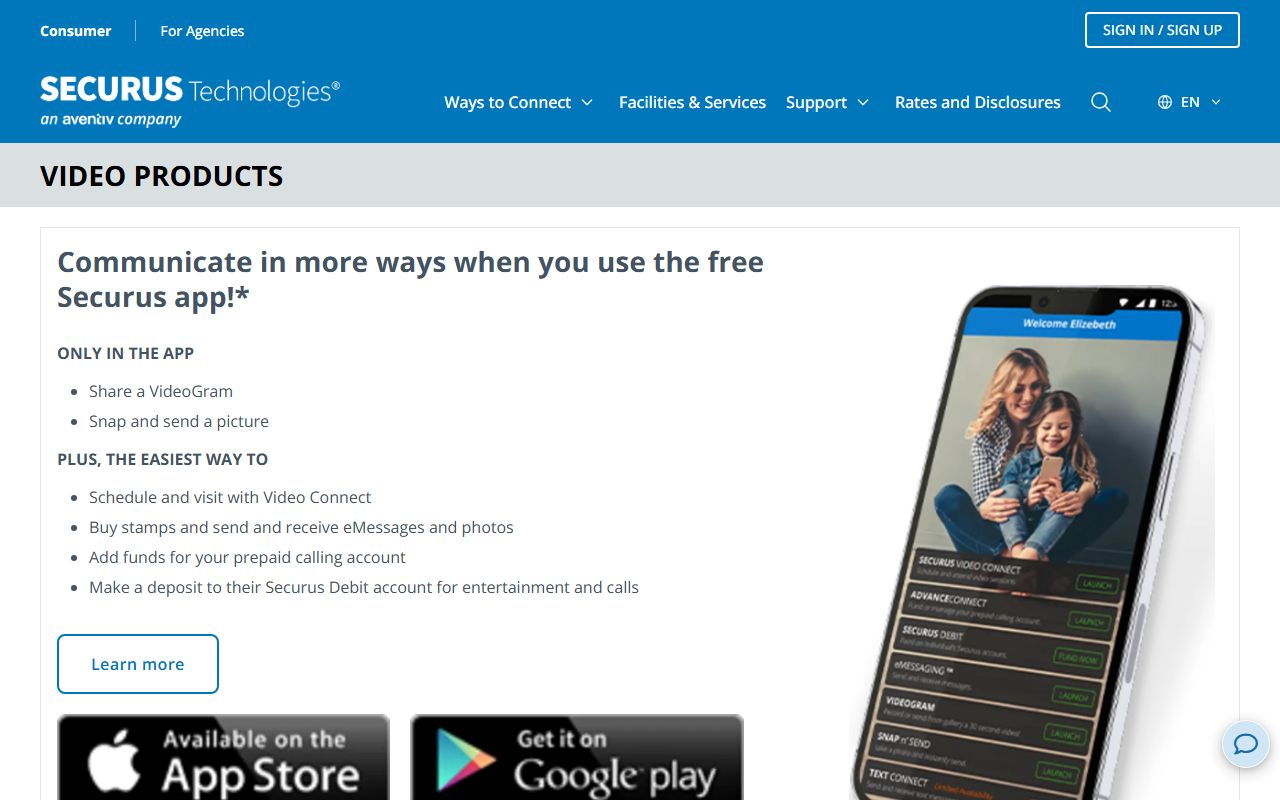
Visits are booked through the video visit scheduling site shown above. The schedule below sums up the rules.
| Item | Rule |
|---|---|
| Scheduling | At least 24 hours in advance; help at 352-491-4511. |
| On-site allowance | Up to two hours per week, Sunday through Saturday. |
| Session structure | Two one-hour sessions, up to two visitors each. |
| Remote internet visit | 30 minutes for $7.95, 8:00 a.m. to 8:00 p.m. |
| Children | Under 24 months do not count toward the visitor limit. |
Mail and Phone Rules
Mail rules at the jail are strict. All incoming mail except legal mail must be a postcard. The postcard must show the inmate's full name and a complete return address, must be pre-stamped, and must fall within set sizes. The jail rejects altered postcards, labels, stickers, tape, drawings, photos, and anything with stains or odor. The jail mailing address is 3333 NE 39th Avenue, Gainesville, FL 32609.
Inmates cannot receive phone calls, but they can make outgoing calls daily from 8:00 a.m. to 10:00 p.m. Calls are monitored and limited to 15 minutes, with a warning before time runs out. These rules keep contact open while the facility controls security.
The postcard-only rule catches many first-time senders off guard. A letter in an envelope, a printed photo, or a child's drawing will be rejected, even when the sender means well. Legal mail is the exception and follows separate handling. If you are not sure an item will pass, keep it simple and use a plain, pre-stamped postcard with the inmate's full name and your full return address. Anything else risks coming back to you.
Money and Commissary
There are several ways to send money to an inmate. A kiosk in the jail lobby takes bills, except $1 bills, and major cards. A money order can go in the lobby drop box, and an ATM sits in the inner lobby. Online deposits and packages run through outside vendors. Each method posts to the same inmate account. The full MNI number is needed for any transaction.
The screenshot shows one online deposit and package vendor.
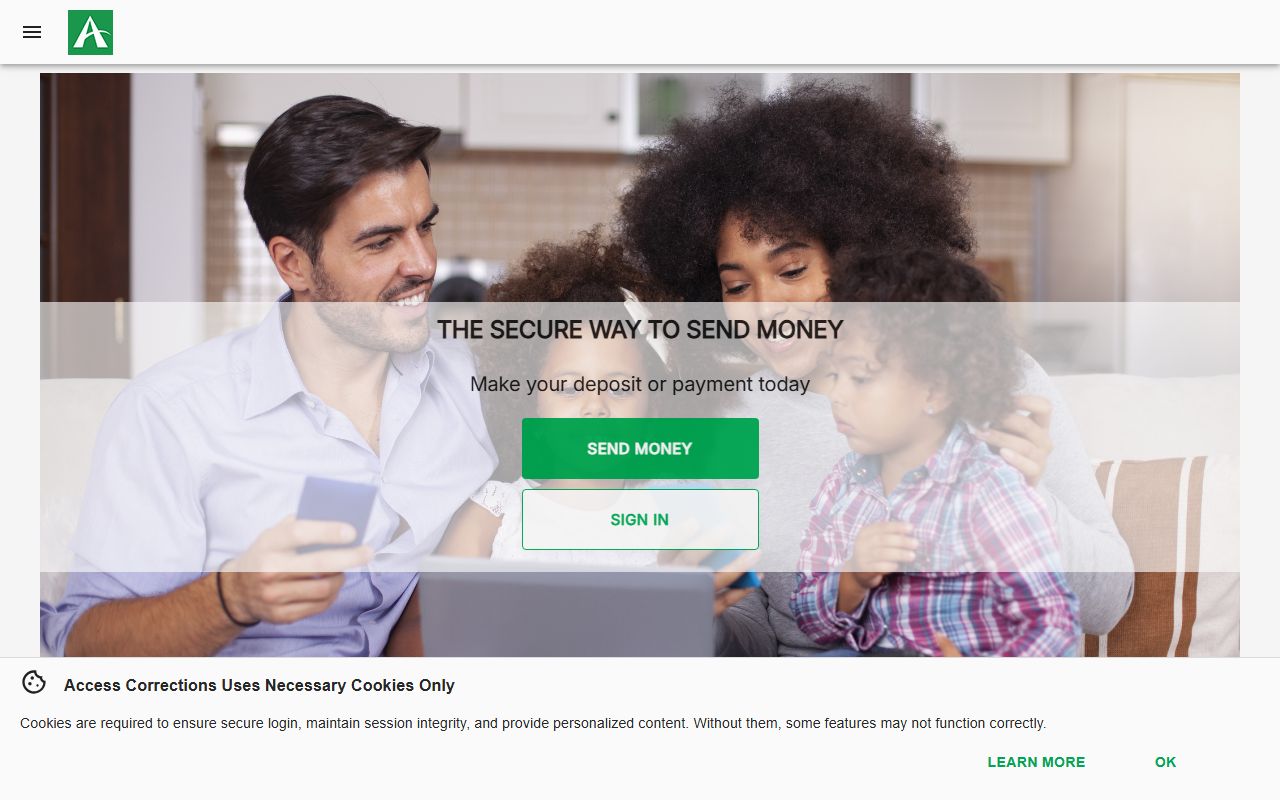
Online deposits run through AccessCorrections shown above, or through Access Securepak for packages. Have the inmate's MNI number ready before you start. Money in an inmate's account funds commissary, phone time, and remote visits, so a small deposit can go a long way during a short stay.
What the Roster Does Not Show
The public roster has limits. It shows an age, not a date of birth, which protects identity to a degree. It does not flag medical, protective-custody, or suicide-watch status. It does not publish a release date in the current detail view. The arrest-agency codes are short and the Sheriff does not post a full code glossary, so treat GPD, ASO, and DOJ as likely Gainesville Police, the Sheriff's Office, and a jail or justice source, without overreading them.
Note: The jail roster reflects current custody only, so a released person drops off the list even though the arrest record still exists elsewhere.
State Prison and Federal Custody Searches
The county jail holds people for up to a year. A person sentenced to longer time goes to state prison under the Florida Department of Corrections, which keeps its own search. A federal case routes to the Bureau of Prisons. These are separate systems from the county roster. The released inmates page covers the state and federal locators and how to set up custody notifications, and the jail population page covers capacity and data. Knowing which system holds a person saves time, since a county search will not show a state prisoner or a federal detainee.