
Why This Is the Circuit Court in Florida
Florida does not use the term district court for its trial courts. The state splits trial work between circuit courts and county courts. There are twenty circuit courts and sixty-seven county courts statewide, under five District Courts of Appeal and the Florida Supreme Court. So in Alachua County, the primary trial court is the Circuit Court, not a district court. The circuit court carries the broad, higher-jurisdiction caseload.
Alachua County is not its own circuit. It is the largest county in the Eighth Judicial Circuit, which groups six counties together. The circuit handles the felony, family, probate, and larger civil matters, while the county court handles the lower-level cases. Understanding this split helps you find the right court for a case. It also explains why a page built around a generic district court does not fit Florida, where the circuit court fills that role at the trial level.
The Eighth Judicial Circuit and Its Counties
The Eighth Judicial Circuit serves Alachua, Baker, Bradford, Gilchrist, Levy, and Union Counties. Alachua County, home to Gainesville and the University of Florida, is the population center and hosts the circuit's court administration office. That office sits on the fourth floor of the Family and Civil Justice Center, and the court administrator can be reached there. The circuit's chief judge oversees administration across all six counties.
Because the circuit spans several counties, a circuit judge may handle matters beyond Alachua County. Still, an Alachua County case is filed with the local Clerk and heard in a Gainesville courthouse. The circuit's website lists the courthouses, the judiciary, and current administrative orders for the county.
Grouping counties into circuits lets the state share judicial resources across a region. A smaller county may not need a full slate of judges, so the circuit model spreads the workload. Alachua County, with Gainesville at its center, anchors the Eighth Circuit because of its size and its role as the county seat. That is why the court administration office and the busiest dockets sit here rather than in the smaller member counties.
Alachua County Circuit and County Judges
The Eighth Judicial Circuit posts the judges who serve Alachua County. Circuit judges hear the higher-jurisdiction trial matters, while county judges hear county-court cases. The chief judge of the circuit is William E. Davis. The table lists a sample of the judges from the circuit's Alachua County page.
| Judge | Court Group |
|---|---|
| William E. Davis | Chief Judge, Alachua Circuit |
| Susanne Wilson Bullard | Alachua Circuit Judiciary |
| Denise R. Ferrero | Alachua Circuit Judiciary |
| James M. Colaw | Alachua Circuit Judiciary |
| Gloria R. Walker | Alachua Circuit Judiciary |
| Joy L. Danne | Alachua County Judiciary |
| Susan Miller-Jones | Alachua County Judiciary |
| Meshon T. Rawls | Alachua County Judiciary |
The circuit's judiciary list changes with appointments and assignments. A recent administrative order updated general assignments in 2026, so check the circuit site for the current roster before relying on a name. Judges can also rotate between divisions, so the judge on a case at filing may not be the judge at trial. The case docket shows the assigned division, which is the reliable way to know who hears a matter at any point.
Circuit Court vs County Court Jurisdiction
The two trial courts split the work by case type and value. The circuit court takes the higher-stakes matters. The county court takes the smaller ones. The comparison below shows the divide that shapes where an Alachua County case is heard.
| Feature | Circuit Court | County Court |
|---|---|---|
| Criminal | Felony cases | Misdemeanor and criminal traffic |
| Civil | Larger civil disputes | Small claims and lower-value civil |
| Family | Divorce, paternity, juvenile | Not handled at this level |
| Other | Probate, guardianship, mental health | Landlord-tenant, civil traffic |
The County Court page covers the lower level in detail, including small claims and civil traffic. The dividing line also turns on the dollar amount of a civil claim, with larger claims going to the circuit court and smaller ones to the county court. So the same kind of dispute can land in either court depending on how much is at stake. Knowing the split helps you file in the right place and search the right docket.
Alachua County Courthouse Locations
The circuit court uses the county's two downtown buildings. Criminal matters sit at one, and civil and family matters sit at the other. The court administration office sits inside the Family and Civil Justice Center. The table lists the buildings and what each handles.
| Building | Address | Handles |
|---|---|---|
| Judge Stephan P. Mickle, Sr. Criminal Courthouse | 220 S. Main St., Gainesville, FL 32601 | Felony, misdemeanor, criminal traffic |
| Family & Civil Justice Center | 201 E. University Ave., Gainesville, FL 32601 | Family, civil, probate, juvenile, mental health |
| Office of Court Administrator | 201 E. University Ave., Room 417 | Circuit administration |
How a Case Moves Through the System
A case follows a path through the court levels. A county court matter starts at the lower level. A circuit court matter starts at the higher trial level. An appeal moves up from the trial court to the District Court of Appeal, and the Florida Supreme Court reviews certain categories.
Case flow: County Court › Circuit Court › District Court of Appeal › Florida Supreme Court
Most cases never reach an appeal, so the trial court is where the work happens. The Clerk records each step on the case docket. The court dockets page explains how to follow those events. Each move up the ladder has its own rules and deadlines, so a missed step can end an appeal before it is heard.
Appeals to the District Court of Appeal
Appeals from Alachua County trial courts go to one of Florida's District Courts of Appeal. The District Court of Appeal reviews the trial court's work for legal error. The Florida Supreme Court then handles certain categories set by the constitution and court rules. Appellate procedure changes over time, so a person considering an appeal should check the current Florida Rules of Appellate Procedure.
An appeal is not a new trial. The appellate court reviews the record for legal error rather than hearing the case over again. That is why the trial court record matters so much, since it is what the appellate court reads. There is also a federal track for some cases. Appeals from the federal trial court in this region go to the U.S. Court of Appeals for the Eleventh Circuit.
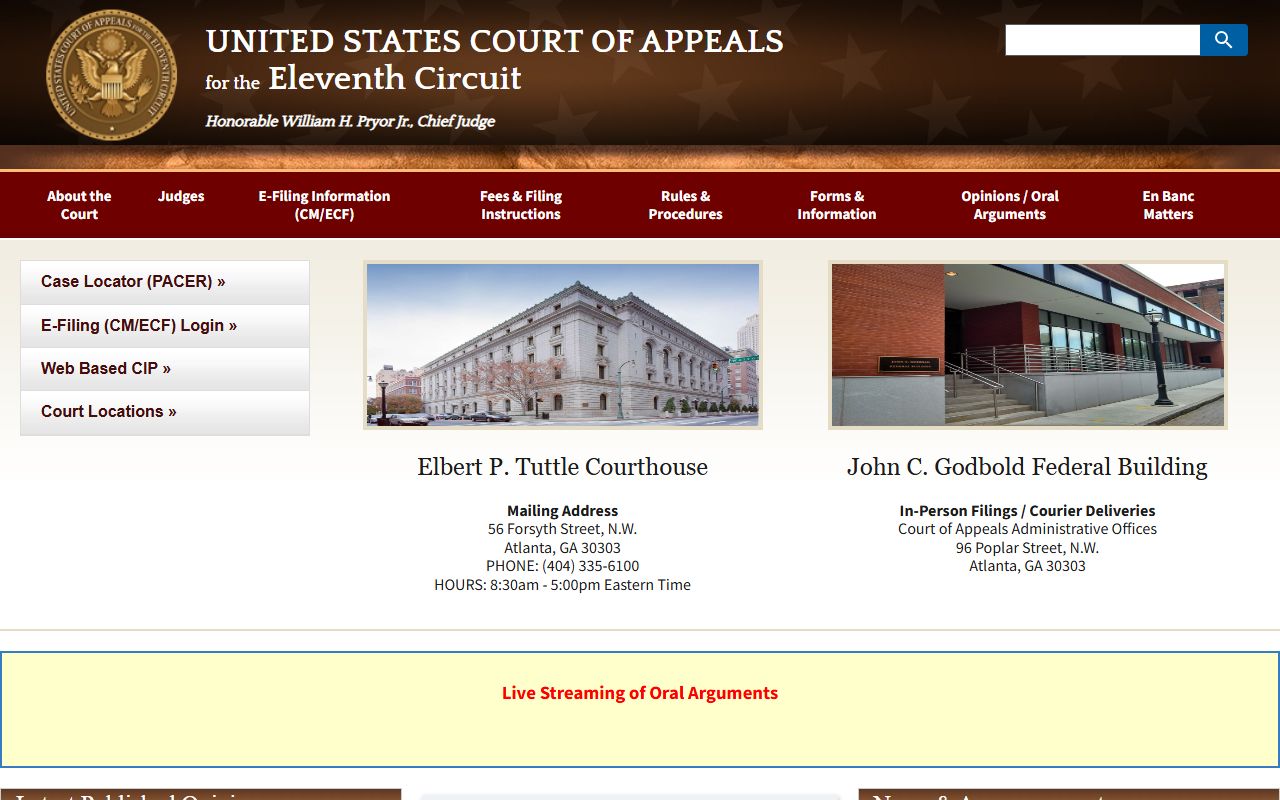
The Eleventh Circuit Court of Appeals shown above hears federal appeals from this region, which is separate from the state appellate track.
Federal Courts Serving Alachua County
Alachua County also sits within the federal court system. It is part of the U.S. District Court for the Northern District of Florida for federal trials. Bankruptcy is handled by the U.S. Bankruptcy Court for the Northern District of Florida. These federal courts are fully separate from the circuit and county courts, with their own records system.
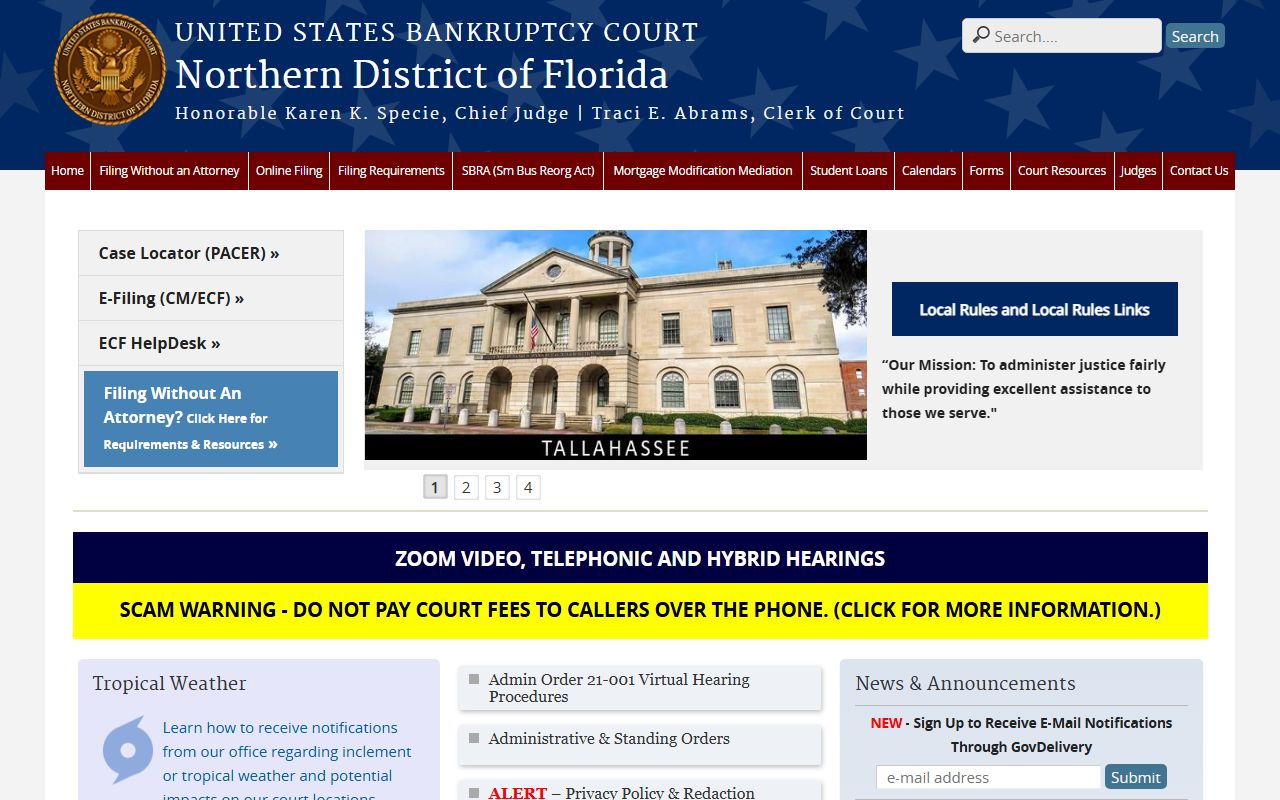
The U.S. Bankruptcy Court shown above handles Chapter 7, 11, 12, and 13 cases for the district. Federal case access runs through PACER, covered on the court records page. A person searching a state case will not find a federal matter in the Clerk's index, and the reverse is also true, so it helps to know which system holds the case.
Specialty Courts in the Eighth Judicial Circuit
The circuit runs problem-solving courts that mix treatment and close court review. Adult Felony Drug Court serves defendants whose crimes tie to substance abuse. Mental Health Court serves defendants whose involvement links to mental illness. A Veterans Treatment Court pairs supervision with VA resources and peer mentors. For details, the circuit lists a Specialty Courts Manager, Sherry Browne, at 352-384-3094.
These courts aim for better outcomes than standard case processing for the right candidates. They are part of the circuit court's work, not a separate court system. A participant agrees to treatment, testing, and regular court appearances, and a judge tracks progress over time. Success can mean a reduced charge or a dismissal under the program's rules, while failure can return a case to the standard track. The State Attorney and the Public Defender both take part, which is covered on the arrest records page.