
How to Apply for an Alachua County Marriage License
The Clerk issues marriage licenses at the Family and Civil Justice Center, 201 East University Avenue. Both parties must appear in person to finalize the license after completing the online application. Marriage services run Monday through Friday, 8:15 a.m. to 4:30 p.m., and appointments can be set at 352-374-3623. Walk-ins are helped between appointments until 4:00 p.m. Florida law sets the issuance steps, which the Clerk follows. Both people need to be present, so plan schedules so neither applicant is missing on the day you finalize the license. There is no blood test in Florida, which keeps the process simple.
The screenshot shows the Florida statute that governs marriage license issuance.
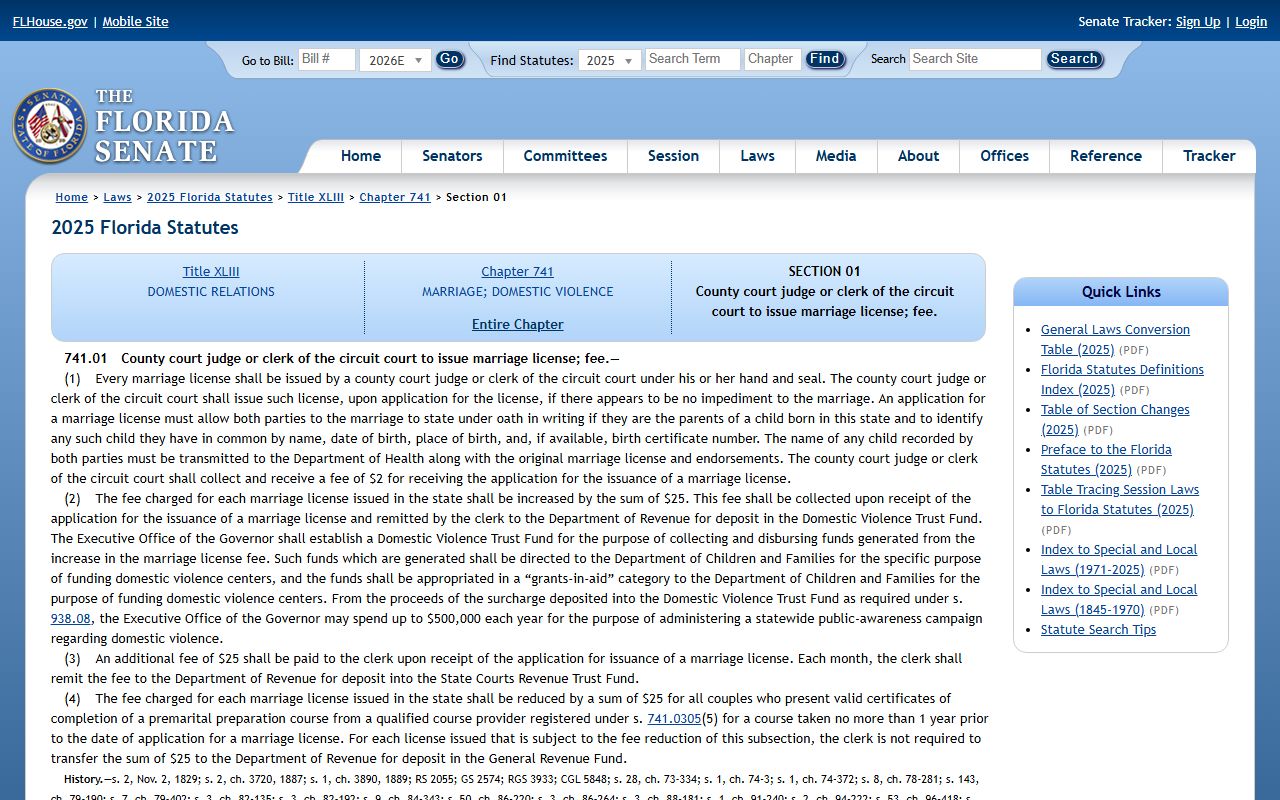
The Clerk's duty to issue licenses comes from Florida Statutes § 741.01 shown above. The steps below outline the process.
- Read the Florida Family Law Handbook, which is required before applying.
- Complete the online marriage license application.
- Both applicants appear at the courthouse with photo ID.
- Bring a premarital course certificate if using the discount.
- Pay the fee, take the oath, and sign the license.
- Hold the ceremony in Florida within 60 days, then return the license to the Clerk.
Alachua County Marriage License Fees
A marriage license has a set fee, and a premarital course lowers it. A courthouse ceremony costs extra. Certified copies of the marriage certificate are available for a small fee. The table lists the current amounts from the Clerk.
| Service | Fee |
|---|---|
| Marriage license without premarital course | $86.00 |
| Marriage license with approved premarital course | $61.00 |
| Civil ceremony by the Clerk | $30.00 |
| Extra certified copy of marriage certificate | $3.00 each |
| Marriage dissolution (divorce) filing | $408.00 |
A credit card adds a small provider service charge. The premarital course discount also waives the resident waiting period, so it can save both money and time. To use the discount, bring the original course completion certificate from an approved provider. The course must meet Florida's requirements, so check that the provider is approved before you sign up. The savings of $25 plus the waived wait can be worth the effort for couples on a tight timeline.
Accepted ID and Prior Marriage Rules
Both applicants must show valid photo identification. The Clerk accepts a Florida driver license or ID card, a U.S. passport, a foreign passport stamped by immigration, a driver license or ID from another state or from Canada or Mexico, and certain military or inmate IDs. Applicants must also know their Social Security number if they have one, since the application asks for it where it applies.
If either party had a prior marriage, the application asks for the date the last marriage ended. That means the divorce decree date or the date a former spouse died, where it applies. Florida also sets minimum-age and consent rules.
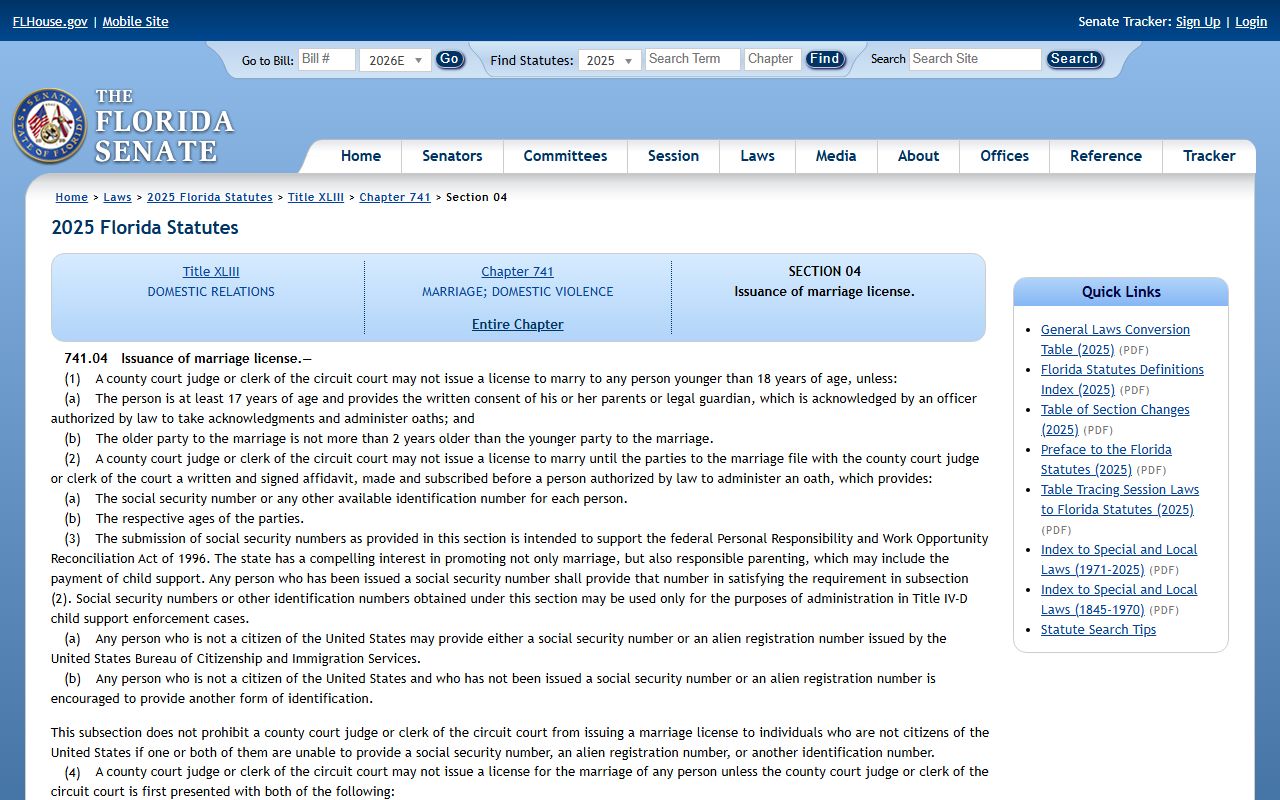
The age and consent rules come from Florida Statutes § 741.04 shown above, which the Clerk's marriage FAQ reflects.
The prior-marriage rule trips up some applicants. If a recent divorce is not yet final, a person is not free to remarry, so the date matters. Bringing the decree or a death certificate helps the Clerk finish the license without a second trip. When in doubt, call the marriage line at 352-374-3623 before the appointment to confirm what to bring.
Waiting Period and 60-Day Validity
Florida residents face a three-day waiting period after the license is issued, unless an approved premarital course waives it. Non-residents have no waiting period. Once issued, the license must be used in Florida within 60 days, or it expires. These rules are short but strict, so plan the ceremony date around them. If the 60 days pass without a ceremony, the couple must apply and pay again for a new license.
Note: A Florida marriage license must be used within 60 days of issuance, and residents wait three days unless an approved premarital course waives it.
Marriage License Application Fields
The application starts online and finishes in person. It collects identity details for both applicants and a few sworn items. The table lists the main fields and requirements from the Clerk's public instructions.
| Field / Requirement | Required | Notes |
|---|---|---|
| Applicant 1 and 2 identity | Yes | Online entry, then in-person ID for both. |
| Social Security number | If applicable | Applicants must know it if they have one. |
| Prior marriage ending date | If applicable | Divorce date or former spouse death date. |
| Family Law Handbook acknowledgement | Yes | Must be read before applying. |
| Premarital course certificate | Optional | Needed for the discount and waiver. |
Who Can Perform the Ceremony
Florida allows several officiants to solemnize a marriage. The list includes ministers and clergy, judicial officers, the Clerk, and Florida notaries. After the ceremony, the officiant and witnesses sign the license, and it goes back to the Clerk for recording. The couple then gets one certified copy.
The screenshot shows the statute that lists authorized officiants.
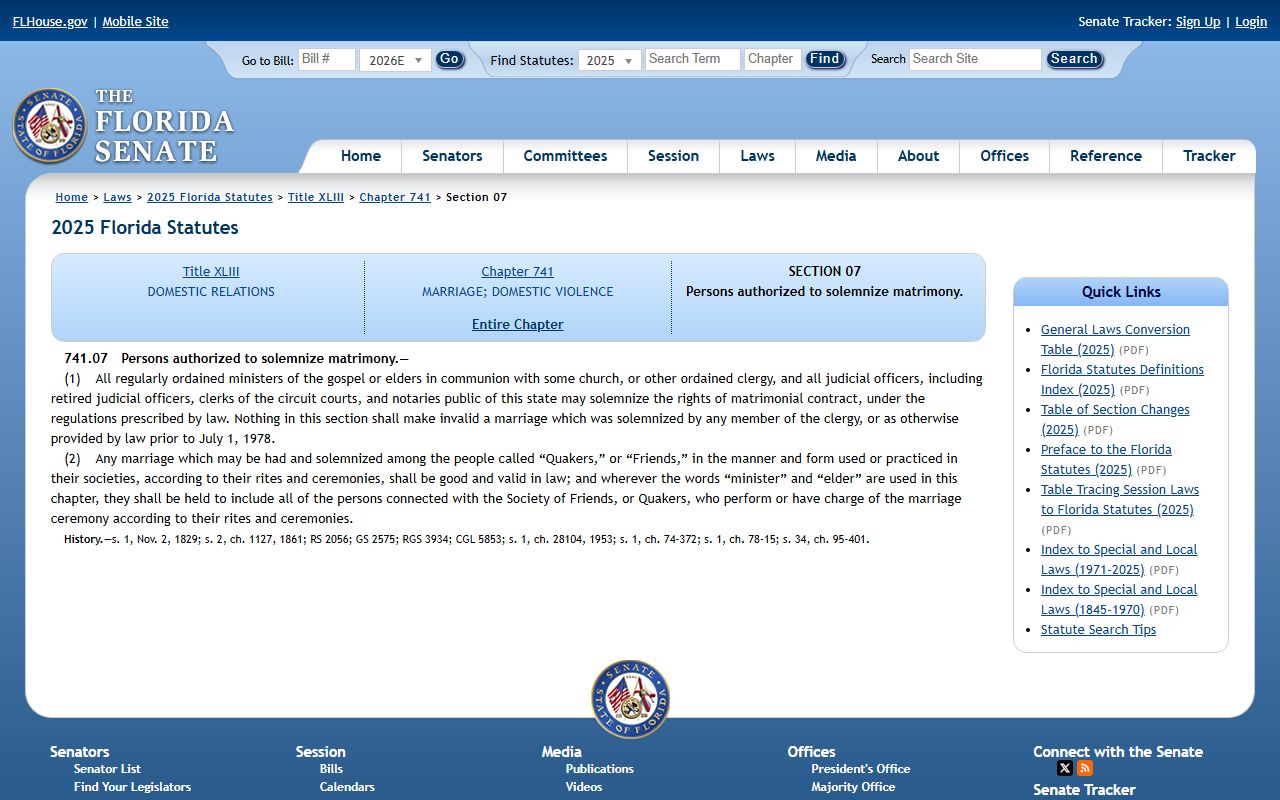
The authorized officiants are set in Florida Statutes § 741.07 shown above. The Clerk can also perform a civil ceremony for a small fee. A courthouse ceremony is a simple, low-cost option for couples who do not want a large event. Florida does not require a witness signature line to be filled by a particular person, but the officiant must sign and return the license so it can be recorded. Until that happens, the marriage is not on record.
Recording and Certified Copies
After the ceremony, the completed license returns to the Clerk by mail or in person for recording. The couple receives one certified copy after recording. Extra certified copies cost $3.00 each. A certified copy is the version other agencies usually accept, such as for a name change, a benefits claim, or proof of marriage.
Marriage records are searchable through the Clerk's official records portal, which offers a marriage menu and party-list search. The public records page covers the official records portal and copy fees. Keep the certified copy you receive in a safe place, since replacing it later means another trip or request. If you need several copies at once, ask for them when you pick up the license rather than coming back, which saves time and a second visit to the courthouse.
Searching Alachua County Divorce Records
Divorce in Florida is called dissolution of marriage. It is a family-law case filed at the Family and Civil Justice Center under the DR code. Divorce records are searched through the Clerk's court records system, the same tool used for other cases. Family files can hold confidential information and restricted document images, so some details may not appear online even when the case itself shows in the index.
To look up a dissolution case, use the Clerk's court records search by party name or case number. Remember that former CA family cases were converted to DR cases, which matters for older filings. The online index shows the docket and many filings, but child, financial, and other protected details may be limited. For a certified copy of a final judgment of dissolution, request it from the Clerk, since a certified copy is what most agencies require to prove a divorce. Older closed family files before 1999 may need research at the courthouse Records Department.
Divorce Fees and Forms
A dissolution filing costs $408.00 at the Clerk. A counterpetition costs $295.00. The Clerk's forms page links Florida Supreme Court family-law forms for dissolution, modification, enforcement, name change, and paternity. The Clerk cannot give legal advice, so it provides forms and intake, not guidance on which option to choose. A filer who cannot afford the fee may apply for civil indigent status, which the Clerk reviews under Florida law. Cases with children add parenting course and parenting plan steps, and the court may order mediation before a final hearing.
- Confirm Florida residency and the right venue.
- Select the correct Supreme Court family-law forms or consult counsel.
- File through the e-portal or in person and pay the fee.
- Serve the other party unless service is waived.
- Complete financial affidavits and any parenting requirements.
- Obtain the final judgment of dissolution.